Inventory and Decision Optimization
From forecasts to feasible operating decisions
Use statistical and machine-learning models, optimization, and simulation to examine decisions—from inventory and resource allocation to thermal process engineering.
Forecasts estimate uncertain inputs; optimization selects feasible actions; simulation explores how systems respond under defined conditions. Their roles are complementary, and each requires evidence appropriate to the decision.
Service overview
Organizations often separate data collection, forecasting, and operational decision-making. An effective analytical process connects them: data describe current conditions, statistical and machine-learning models estimate uncertain inputs, and optimization selects feasible actions under explicit objectives and constraints. Simulation then examines how a proposed policy or process behaves across operating conditions and over time.
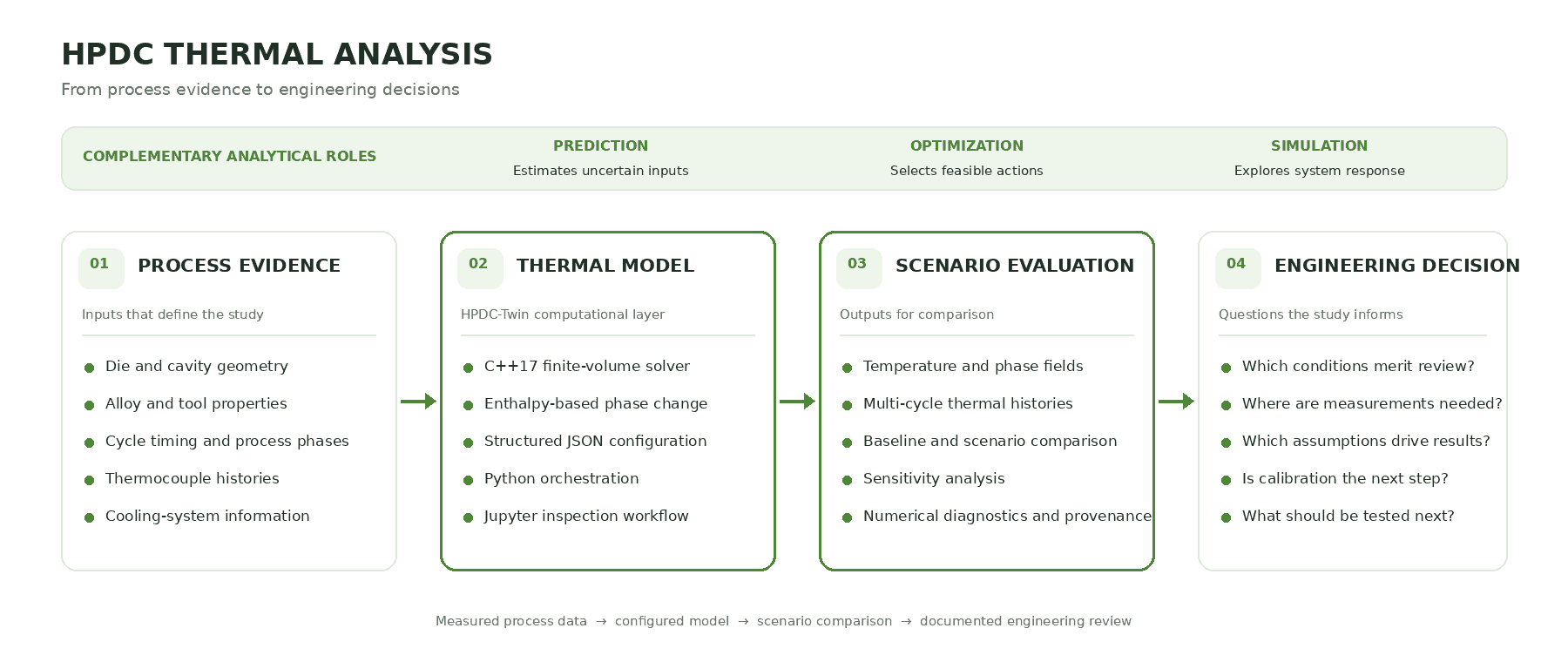
The same decision discipline applies to physical manufacturing systems, although the model type changes. In high-pressure die casting (HPDC), a thermal simulation represents heat transfer and solidification across the casting–die cycle. It allows engineering teams to organize process evidence, compare defined thermal scenarios, and connect computed behavior to measurements and engineering questions.
Bamboos Consulting supports scoped analytical assessments spanning inventory policy, resource allocation, scheduling, and industrial process simulation. For Italian industrial SMEs, relevant starting points include warehouse replenishment and capacity planning as well as thermal process studies for foundries, die manufacturers, and engineering partners.
Questions suitable for a bounded assessment
Methods are selected after evaluating the data, decision variables, and practical constraints.
When and how much to replenish
Compare reorder-point, forecast-driven, and constrained policies under demand and lead-time uncertainty.
Which tasks and resources to assign
Evaluate capacity limits, picking workload, stock locations, service priorities, and operational handoffs.
How to allocate constrained supply
Study allocations, route or delivery restrictions, service targets, and tradeoffs between costs and availability.
Which rule remains feasible
Identify whether a mathematically attractive solution survives staffing, cash, timing, and implementation limits.
How does a thermal process evolves?
Analyze HPDC thermal histories and scenarios using material properties, cycle timing, temperature data, and cooling conditions.
Illustrative decision: replenishment under uncertain lead times
A distributor must decide replenishment quantities when demand is variable, suppliers have delivery delays, and cash or storage capacity is limited. An optimization model may minimize expected stockout and holding costs subject to order-size constraints. A simulation can then compare the proposed policy with the existing rule over common demand and delay scenarios.
The evaluation should report service level, stockouts, working-capital requirements, constraint violations, and sensitivity to forecast error. These quantities are proposed evaluation outputs; no savings or performance improvements are asserted without running the specified study.
A decision method is useful only if the operational system can implement it. The methods are complementary rather than interchangeable. Their roles depend on whether the task is to estimate an uncertain condition, choose an action, or understand how a system responds. Estimate uncertain inputs from observed data—for example, demand, supplier lead times, process conditions, or parameter ranges. The output is an estimate or distribution; it does not select an operating decision by itself. Select feasible actions by defining decision variables, objectives, and constraints. Typical outputs include replenishment quantities, resource allocations, schedules, or candidate operating settings. Explore how a modeled system responds under specified conditions. Outputs may include trajectories, state histories, scenario comparisons, sensitivity measures, and diagnostics.
In inventory management, forecasting may estimate demand, optimization may select replenishment quantities, and simulation may examine service levels and stockouts over time. In HPDC, the central analytical layer is a physics-based thermal simulation: it examines the response of the casting–die system under defined materials, geometry, cycle, and cooling inputs. Optimization can complement that analysis when controllable process variables, objectives, and operational constraints are explicitly formulated.Assess, model, compare, and decide
Prediction, optimization, and simulation solve different parts of a decision
Forecasting and machine learning
Mathematical optimization
Simulation and computational modeling
High-pressure die casting is a repeated thermal process. Heat moves between molten alloy, casting, die, and cooling system; solidification progresses through the cycle; and the tool’s temperature field evolves from shot to shot. A useful computational study connects this physical sequence to process records, temperature measurements, and a defined engineering decision. A typical cycle brings the die into contact with molten alloy, transfers heat through the casting–die interface, advances solidification, and then proceeds through ejection, die preparation, and cooling before the next shot. Initial die temperature, alloy and tool properties, local geometry, contact conditions, cycle timing, and cooling configuration all influence the transient response. Looking at one temperature value in isolation can therefore miss the relationship between process phase, location, and successive cycles. Die and cavity sections, insert dimensions, casting thickness, sensor positions, alloy and die grades, and relevant thermal properties such as density, heat capacity, conductivity, and phase-change data. Cycle identifiers, injection/contact timing, solidification, ejection, spray or cooling phases, initial temperatures, and the operating conditions associated with each run. Thermocouple time histories, sensor type and coordinates, installation depth, calibration information, sampling interval, units, and measurement uncertainty. Available inlet/outlet temperatures, flow or pressure records, and cooling-channel or insert descriptions. Sensor and cycle metadata preserve the context needed for comparison.
The workflow makes several complementary outputs available for review: Thermal simulation supplies a process-response model; optimization supplies a systematic way to search candidate settings. Once a customer-specific study has defined controllable variables, operating bounds, and measurement-based evaluation criteria, a separately scoped simulation-based optimization work package can evaluate combinations of selected process settings. Depending on the process and model scope, candidate variables may include initial die temperature, selected cycle timings, and cooling conditions represented in the study. Agree thermal-history targets, peak-temperature or cooling-rate criteria, cycle-to-cycle behavior, and the equipment, material, and process constraints that candidate settings must respect. Use the thermal model to evaluate candidate combinations, compare tradeoffs, and produce a ranked set of scenarios for engineering review and, where appropriate, measured trials.
Where measured comparison is in scope, candidate evaluation measures include temperature-history MAE/RMSE, peak-temperature difference, time-to-peak, cooling-rate behavior, cycle-to-cycle drift, and residual patterns by sensor location or operating condition. The measurement basis, operating envelope, metrics, and aggregation rules are agreed before calibration; complete cycles or operating conditions provide more meaningful holdout units than randomly selected adjacent time samples. Explore HPDC Thermal Simulation and Engineering Services for the dedicated service description and engagement pathway.
The E-Flow warehouse management software project was a historical operational deployment covering warehouse and distribution workflows. Its reported operational scale was approximately 20 million individual items tracked annually, representing goods with approximately €14 million in total purchase value. These figures describe the volume and purchase value of items handled, not sales revenue or software-attributable savings. They are owner-reported historical deployment context, not independent evidence of improvements from a present optimization algorithm. The separate Machine Learning and Optimization resource explains forecasting, mathematical programming, uncertainty, and simulation-based optimization. The finite-rule agentic controller preprint presents experiments in a stylized inventory simulation; it is research evidence under experimental assumptions, not an operational deployment of those controllers. The preferred starting point may be an operational review, a classical optimization model, a predictive model, or a physics-based simulation—not necessarily a machine-learning or quantum algorithm.HPDC thermal simulation: connecting process physics to engineering choices
Why the cycle history matters
What a customer-specific study connects
Define the thermal domain
Represent the production cycle
Connect model and observations
Describe heat extraction
From thermal outputs to engineering questions
Connecting thermal simulation to process optimization
Define what can be changed
Specify what constitutes a better setting
Evaluate feasible alternatives
Operational software experience and research boundaries
Typical technical deliverables
Related methods and services. For concrete inventory methods, compare inventory forecasting with decision optimization and quantum inventory optimization and classical baselines. The HPDC application above extends the page’s discussion of simulation into physics-based process engineering.
Discuss an Optimization or Simulation Project
Start with the decision, process evidence, and constraints.
An initial discussion can examine inventory records, planning constraints, existing decision rules, process measurements, thermal-analysis requirements, or computational modeling objectives. The purpose is to define a bounded assessment and the evidence needed to compare alternatives.
Explore Technical Resources and our AI Consulting & Computational Systems overview. Additional analysis appears on Substack. Research material is subject to the website’s Terms of Use.
References and Further Reading
External sources provide technical context and are not endorsements of Bamboos Consulting. Source status is identified where relevant.
- Google. OR-Tools: Optimization and Operations Research (official software documentation). Documentation.
- Boyd, S., & Vandenberghe, L. (2004). Convex Optimization. Cambridge University Press. Stanford resource.
- Scikit-learn developers. Common pitfalls and recommended practices (software documentation). Documentation.
- Bamboos Consulting. E-Flow Warehouse Management Software (historical software description). Project page.
- Kunz, G., Strelow, O., & Beckmann, M. (2014). Dynamic modeling of fluid-cooled tools in periodic thermal processes. International Journal of Thermal Sciences, 84, 228–251. DOI.