Thermal Simulation for High-Pressure Die Casting
Connect die-temperature histories with practical engineering decisions
Thermal simulation and scenario analysis for high-pressure die casting, cooling configurations, and solidification behavior.
A staged engineering engagement can begin with process-data assessment and progress to customer-specific simulation and measurement-led evaluation.
Computational engineering for process understanding, thermal scenario analysis, and customer-specific model development.
High-pressure die casting is a repeated thermal process. Die temperature, solidification, cooling conditions, material properties, and cycle timing interact. Bamboos Consulting provides a staged engineering service to help manufacturers and engineering teams examine these interactions, assess available process data, and determine which computational analysis is appropriate for a defined engineering question.
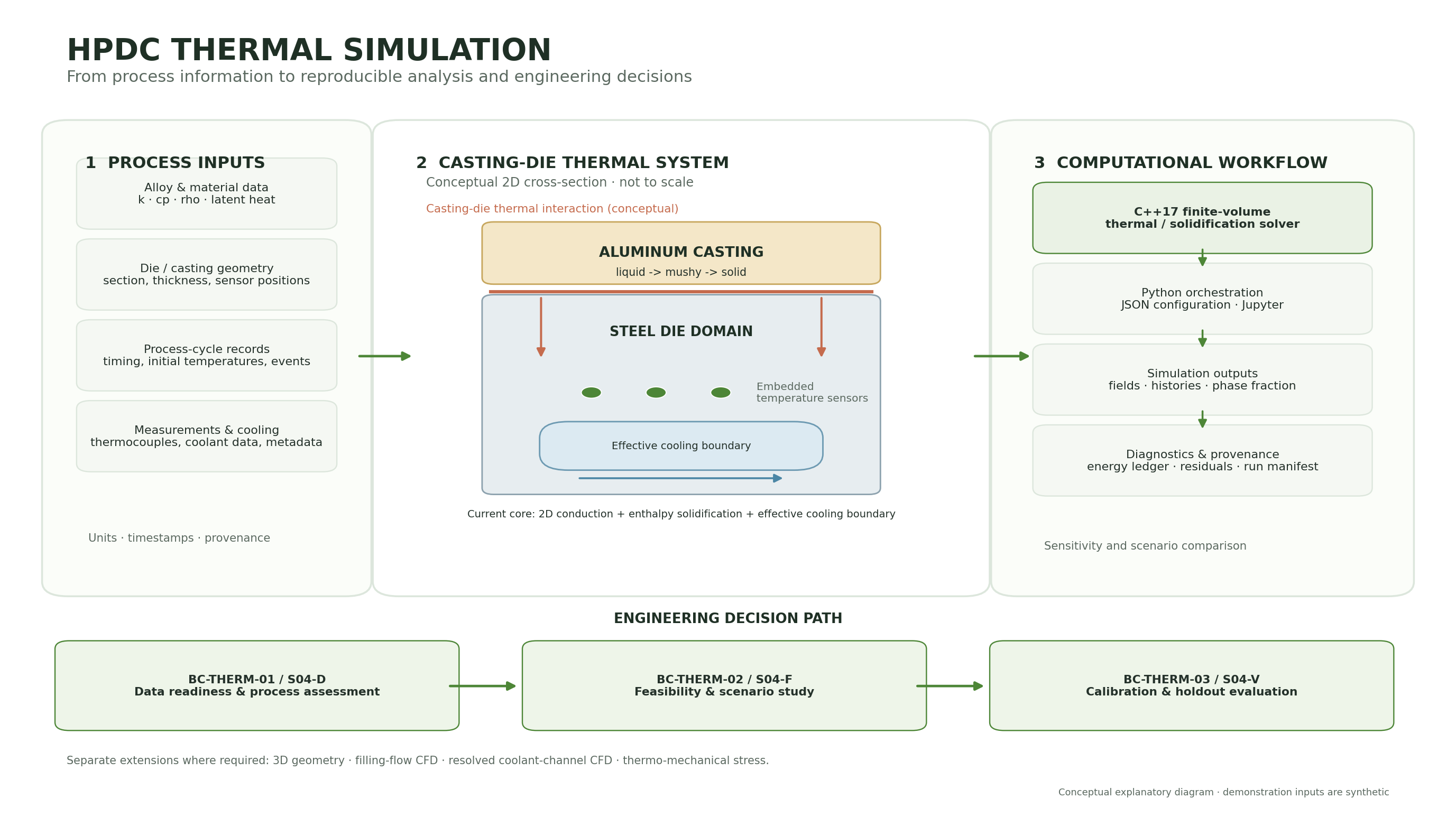
HPDC-Twin: a computational starting point for engineering studies
HPDC-Twin is a Bamboos-developed C++17 thermal and solidification research prototype connected to a Python/Jupyter workbench. Its numerical research foundation supports structured thermal analysis, scenario exploration, and traceable computational studies. The Python workbench configures and orchestrates the compiled solver, reads its outputs, and supports visualization and diagnostics.
- Structured JSON configuration and reproducible run setup.
- Thermal summaries and optional spatial-field CSV outputs.
- Temperature and phase-fraction field inspection.
- Multi-cycle scenario runs and sensitivity analysis for selected parameters.
- Numerical diagnostics and run provenance.
The workflow provides a practical starting point for a customer-specific engagement: define the process question, organize available measurements, evaluate selected thermal scenarios, and develop an evidence-based engineering report.
Download the HPDC-Twin technical overview and demonstration report (PDF).
Engineering questions that can be examined
- How do recorded die-temperature histories vary across process stages and successive cycles?
- Which material, process, or cooling inputs are available and sufficiently documented for a thermal study?
- How do selected modeled thermal-boundary or operating scenarios change the computed thermal response?
- Which additional measurements or geometry details would improve the usefulness of a customer-specific study?
- How does a calibrated model behave on operating cycles or conditions not used for calibration?
The appropriate outputs and acceptance measures are defined against the customer’s question, available measurements, and model scope.
Three staged engineering engagements
BC-THERM-01 | Thermal Data-Readiness Gate (S04-D)
Establish whether the available process information can support a useful thermal-analysis study. Review the engineering question, alloy and die materials, simplified geometry, cycle timing, temperature records, sensor metadata, cooling information, and data provenance. The result is a data inventory, model-applicability assessment, prioritized measurement plan, and a bounded proposal for further work.
Indicative effort: 3–5 working days. Download the BC-THERM-01 service brief (PDF).
BC-THERM-02 | Thermal Feasibility and Scenario Study (S04-F)
Adapt a bounded thermal model to a defined HPDC question and compare a baseline with selected operating or thermal-boundary scenarios. The study uses representative measured data, maps model outputs to available measurement locations, examines sensitivity, and preserves an agreed holdout dataset for subsequent independent evaluation.
Indicative effort: 12–25 working days. Download the BC-THERM-02 service brief (PDF).
BC-THERM-03 | Thermal Calibration and Independent Validation Pilot (S04-V)
Calibrate selected parameters on designated process cycles or operating conditions, then evaluate the frozen model on independent holdout cycles or conditions. Metrics and thresholds are agreed before calibration. The report documents the calibration, sensor-level residuals, sensitivity, operating envelope, and implications for further engineering work.
Indicative effort: 25–50 working days. Download the BC-THERM-03 service brief (PDF).
Information useful for an initial assessment
A first discussion can begin with partial information. Depending on the question, useful inputs include die/cavity geometry and sensor positions; alloy and die material identification; cycle sequence and process timing; thermocouple histories and sensor metadata; initial temperatures; cooling-system information; and cycle identifiers or operating-condition records. The data-readiness assessment identifies which additional information would materially improve the next study.
From an initial study to an engineering partnership
Customers can begin with a focused assessment, progress to a scenario comparison, and commission a measurement-led evaluation. The resulting work can inform process engineering, tooling discussions, thermal instrumentation, and subsequent simulation development.
Related methods
For broader material on mathematical optimization, uncertainty, simulation, and computational decision support, see the Machine Learning and Optimization resource. For the wider service portfolio, see AI Consulting and Computational Systems.
Discuss a thermal-analysis requirement
Start with the process question and the information already available.
If your team is reviewing die-temperature behavior, cooling conditions, or the thermal response of an HPDC process, an initial discussion can clarify the engineering objective, the process records available, and the most useful scope for an assessment or scenario study.
Read the HPDC-Twin technical overview and demonstration report or explore Bamboos Consulting services.