Quantum Inventory Optimization: Connecting Machine Learning, QUBO, and Operational Outcomes
Inventory decisions can be computationally difficult when many products share limited storage, purchasing budgets, transportation capacity, or supplier constraints. Quantum optimization is one possible experimental approach to some discrete versions of these problems. The meaningful question, however, is not simply whether a quantum algorithm returns a low objective value. It is whether the proposed inventory decision is feasible, economically useful, and preferable to available classical alternatives.
There is also a practical connection to machine learning. A learned demand model can estimate quantities, demand distributions, or scenarios that enter the optimization problem. The learning model and the optimization method then form a decision pipeline whose performance must be evaluated jointly—but whose errors should also be measured separately.
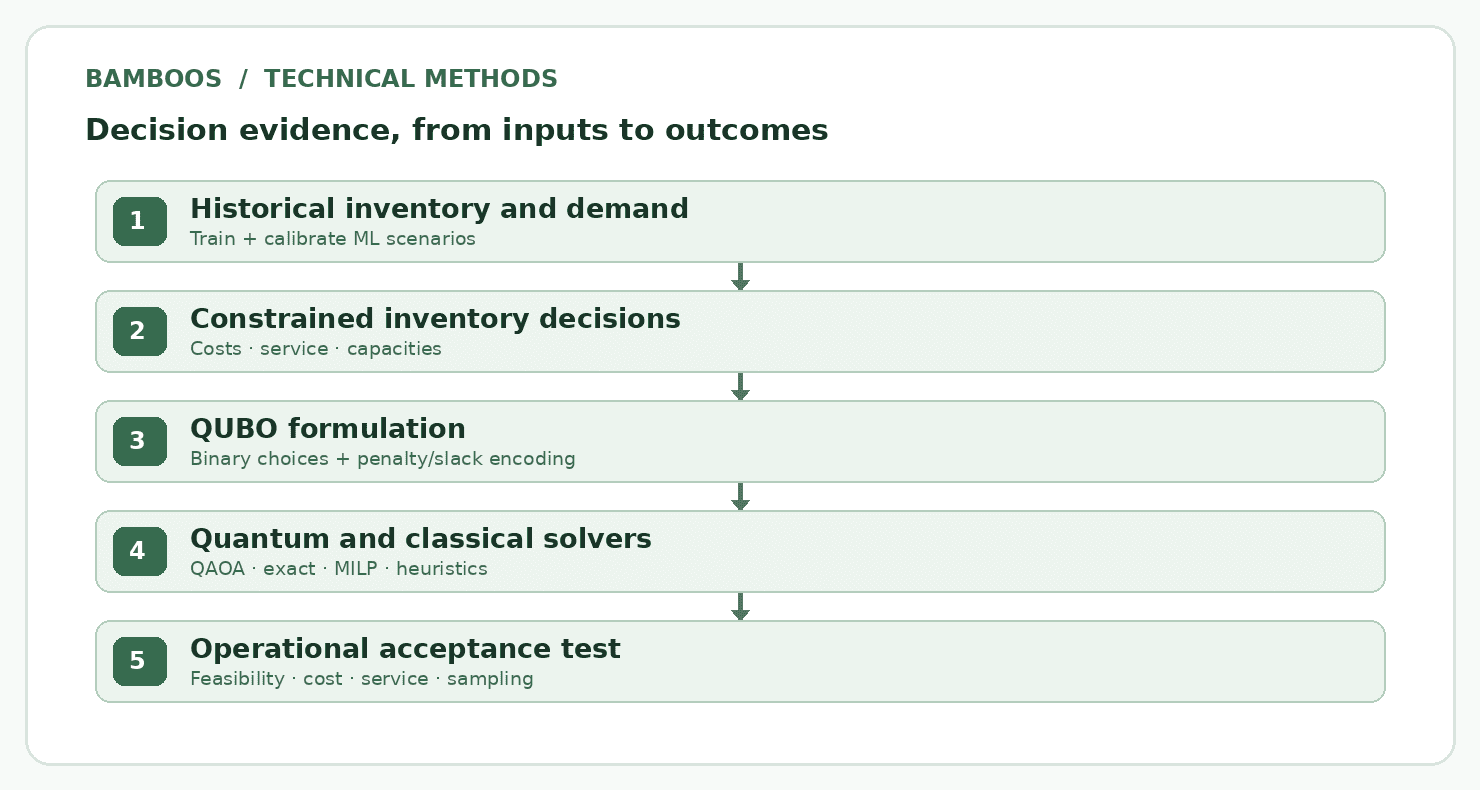
Step 1: Learn the uncertain operating inputs
Suppose a distributor must decide which spare parts to replenish before the next delivery. Historical sales, prices, lead times, promotions, and stockouts can help estimate future demand. A supervised learning model may produce demand quantiles or scenario probabilities, while a simple historical benchmark provides a reference.
The information boundary matters. Models must not use outcomes unavailable at ordering time, and stocked-out sales must not be equated automatically with total demand. Compare calibration and forecast errors on held-out periods. Research relating forecast accuracy to inventory performance shows why an accurate predictor is not automatically the best input for an inventory policy.
For the optimization experiment, freeze the forecast model and its validation assumptions. Otherwise, an apparent improvement attributed to QAOA may actually result from changing the demand model, the objective, or the constraints between experiments.
Step 2: Convert the operational choice into binary variables
In a simplified example, let x_i equal 1 when item i is included in a replenishment batch and 0 otherwise. Each choice has a value or expected cost, occupies warehouse capacity, and consumes purchasing budget. The original optimization should be stated with its real constraints before a quantum encoding is attempted.
A quadratic unconstrained binary optimization model (QUBO) assigns an energy to each binary decision vector. A schematic objective is:
E(x, s) = Σ_i c_i x_i + λ (Σ_i v_i x_i + s − B)², with x_i ∈ {0,1} and a suitably binary-encoded slack variable s ≥ 0.
Here, B is an integer capacity limit, v_i is the corresponding use of capacity, and λ is a penalty weight. This is an illustration of how a capacity inequality may be transformed into a quadratic penalty using slack; a penalty of the form (Σ_i v_i x_i − B)² without slack would instead favor filling capacity exactly. More complicated constraints, multiple quantities per item, and stochastic costs require additional modeling choices.
The QUBO representation does not make an optimization problem intrinsically quantum: exact enumeration, mixed-integer optimization, simulated annealing, and other classical methods can also solve or approximate it.
Step 3: Test QAOA against meaningful baselines
The Quantum Approximate Optimization Algorithm (QAOA) uses parameterized quantum circuits and a classical parameter optimizer to sample candidate binary solutions. The foundational method was described by Farhi, Goldstone, and Gutmann. A shallow circuit can be evaluated experimentally, but its performance is sensitive to the formulation, chosen depth, parameter search, noise, and measurement budget.
The relevant comparison includes at least one exact solution for small instances, a classical integer-programming baseline where applicable, and an inexpensive heuristic. All solvers should receive the same objective and constraints. Record wall-clock time consistently, including QUBO construction, parameter tuning, circuit evaluation, sampling, and feasibility repair.
Earlier work has already examined QUBO-based inventory optimization on classical, quantum, and hybrid hardware, so the existence of an inventory QUBO or a QAOA circuit is not by itself a novel finding or evidence of quantum advantage.
Step 4: Distinguish objective quality from operational acceptance
A low QUBO energy may hide a violated constraint when penalty weights are insufficient. A high rate of exact-optimum recovery may be unnecessary if several near-optimal inventory choices produce similar practical outcomes. Conversely, a nearly optimal encoded solution may cause costly shortages under different demand scenarios.
Measure at least three levels of evidence: formulation fidelity (does the QUBO represent the actual constraints and costs?), solver fidelity (how close are sampled decisions to the best known feasible solution?), and operational fidelity (how do those decisions perform under subsequent demand and delivery uncertainty?).
For the operational test, run the chosen inventory actions through a stochastic simulator with the same held-out demand and lead-time scenarios used for classical alternatives. Report fill rate, holding and shortage costs, capacity violations, sensitivity to model error, and the number of solver samples needed to obtain an acceptable decision. Use repeated trials and uncertainty intervals, not a single favorable execution.
Relation to ongoing research
A related research preprint available on Research Square (version 1) is included as a further reading link. The present article does not rely on unverified numerical claims about hardware performance or quantum advantage. Results and experimental boundaries should be assessed from the research manuscript itself.
There is a wider operations-research context as well: Harwood and colleagues study optimization formulations for routing problems from a quantum-computing perspective. This reinforces the need to separate mathematical representation from claims about what current hardware can achieve.
What an organization can reasonably conclude
Quantum optimization is worth investigating when a constrained decision is naturally discrete, classical baselines are well defined, and experiment size permits reproducible comparison. For current applied work, the most defensible output is often a benchmark showing which instances, conditions, and budgets make a method competitive—not a claim that quantum computing has already improved a production inventory system.
An ML-informed, quantum-classical workflow is therefore best assessed as one complete decision process: data quality → demand learning → constrained formulation → solver comparison → operational simulation. Only the final stage indicates whether the proposal is useful for inventory management.
Compare Optimization Methods for Inventory Decisions
Are you evaluating inventory allocation, replenishment policies, or resource-constrained scheduling problems that require computational optimization?
Bamboos Consulting can help formulate the decision problem, establish classical optimization benchmarks, and investigate experimental approaches, including quantum-inspired and quantum optimization methods where technically justified.
The objective is to assess solution quality, computational requirements, operational feasibility, and the evidence supporting any claimed advantage.
Explore the methods discussed in Machine Learning & Optimization, consult our Technical Resources, and follow research commentary on Substack.
References
- Garrone, R. Related Research Square preprint (version 1). Research Square.
- Farhi, E., Goldstone, J., & Gutmann, S. (2014). A Quantum Approximate Optimization Algorithm. arXiv, 1411.4028.
- Fernandes, G. P. L. M., et al. (2024). Optimization Algorithm for Inventory Management on Classical, Quantum and Quantum-Hybrid Hardware. arXiv, 2411.11756.
- Harwood, S., et al. (2021). Formulating and Solving Routing Problems on Quantum Computers. IEEE Transactions on Quantum Engineering, 2.
- Theodorou, E., Spiliotis, E., & Assimakopoulos, V. (2025). Forecast accuracy and inventory performance. European Journal of Operational Research, 322(2), 414–426.