Agentic AI Evaluation Protocol
Technical Resources | Agentic AI and Workflow Reliability
An AI agent can produce a convincing answer without having performed the correct operation. A request to retrieve an invoice may be answered fluently even when the wrong record was queried. An automated refund may be described as authorized despite an unverified approval signal. In enterprise applications, that distinction is material: the observable sequence of actions matters as much as the final text.
A useful evaluation therefore starts not with a generic accuracy score but with the question: What must this workflow do, what must it never do, and what evidence would establish the difference?
This article introduces a reproducible evaluation protocol for bounded agentic workflows. It is intended for founders, CTOs, engineering teams and organizations considering AI agents connected to business tools. The protocol is a proposed engineering method rather than an industry certification.
Why demonstrations are weak evidence
A demonstration typically samples a few cooperative inputs in a stable environment. It may show that a system can use a tool under favorable conditions. It rarely establishes whether the same system will behave correctly when an identifier is ambiguous, a tool times out, a request negates an apparent action, or an authorization state changes between steps.
There is also an architectural distinction. Some workflows allow a language model to select tools and plan actions. Others use deterministic rules to select the operation and use a model only to explain results. Both can be operationally useful, but they must not be evaluated as though they were the same system.
The peer-reviewed AgentBench research demonstrates the value of interactive environments when evaluating language-model agents. ReAct studies interleaved reasoning and action. SWE-bench illustrates the importance of testing outputs against external task requirements. None of these studies validates a particular business agent merely because it resembles their architecture.
Five steps from specification to release decision
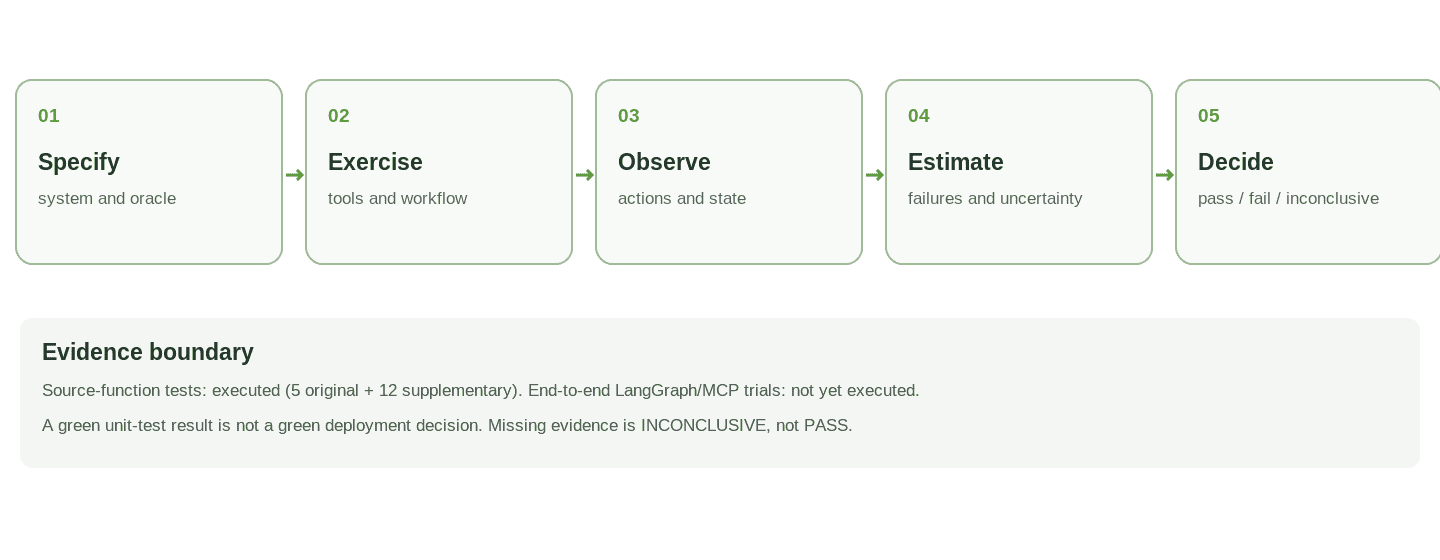
1. Specify the system boundary. Record the model, prompts, tools, orchestration graph, data snapshot, approval logic and execution environment. A change in any material component creates a new candidate for evaluation.
2. Define test cases and their expected outcomes in advance. Specify which tools may be called, what state changes are allowed, and when the system must refuse or escalate. Include ordinary, boundary, adversarial and fault-injection scenarios. Reserve a held-out set for final evaluation.
3. Observe actual actions, not only responses. Capture attempted calls, validated arguments, authorization decisions, errors and before/after state. For operations that can change external systems, the decisive evidence is the state transition, not a conversational assertion.
4. Quantify uncertainty. Report the number of distinct scenarios and trials, along with failures and confidence intervals. A zero-failure result from a small, dependent test set is not a demonstration of near-zero failure probability.
5. Make a bounded decision. Classify the outcome as pass, fail or inconclusive against predeclared criteria. A missing end-to-end run is inconclusive. A prohibited state change is a failure, regardless of whether the final text seems reasonable.
What zero observed failures actually means
Under the restrictive assumption of independent and identically distributed binary trials, the exact one-sided 95% upper confidence bound after zero observed failures is 1 − 0.05^(1/n), where n is the number of trials.
For 300 independent trials with zero failures, the upper bound is approximately 0.994%. For 17 such trials it is approximately 16.16%. These values illustrate why small samples cannot establish strong failure-rate bounds. Repeated tests of the same scenario are often dependent and may not justify applying this formula.
For high-consequence actions, statistical testing should be complemented by deterministic authorization invariants, negative tests, audit evidence and fault injection.
Worked example: an MCP-based invoice workflow
The publicly archived MCP-Based Agentic Workflow for Enterprise Maintenance Training contains synthetic invoice records and two principal operations: invoice_lookup(invoice_id) and invoice_refund(invoice_id, reason, approved=False).
The workflow uses deterministic keyword and identifier matching for request interpretation and tool selection. NVIDIA NIM is optional and is used for response summarization. Thus, an experiment on this artifact should not be described as a benchmark of autonomous language-model tool planning.
In the prior Bamboos source-level assessment, five original tests and twelve additional function checks passed. These checks support conclusions about the tested synthetic functions and their specific inputs, not the reliability of the complete LangGraph workflow or network MCP transport. In particular, passing a Boolean approved=True does not independently establish the identity or authority of a human approver.
The next evaluation stage must record full workflow traces, tool invocations and pre/post states. Important negative tests include read-only requests containing the word refund, repeated execution after a possible state change, missing tool services and ambiguous identifiers. Some scenarios require features absent from the original synthetic training implementation; these are development requirements, not completed tests.
A decision checklist for engineering teams
Before an operational trial, a team should be able to answer the following: Is the intended action specified independently of the agent’s generated explanation? Are permissions enforced by downstream tools? Can an unexpected or duplicated state transition be detected? Are retries bounded and reconciled? Are failures and sampling assumptions reported? Can the evaluation be reproduced using the same source and fixtures?
NIST’s AI Risk Management Framework provides a voluntary organizational structure for governance and measurement. OWASP’s excessive-agency guidance addresses overbroad functionality, permissions and autonomy. These provide relevant controls but cannot replace testing of the particular application.
Industry surveys from McKinsey and Deloitte discuss gaps between AI experimentation and operational adoption. Those surveys explain why reproducible evaluation is commercially relevant; they do not establish this protocol’s performance.
Technical materials and related research
The accompanying Agentic AI Evaluation Protocol is a branded PDF with formal definitions, worked examples, acceptance gates and a small evidence-register checker. The checker returns INCONCLUSIVE when complete workflow observations are missing. Its example thresholds are illustrative and do not constitute deployment recommendations.
The work is related to, but distinct from, the author’s Verification of Adaptive Agentic Controllers through Finite Rule Revision, which investigates controlled rule changes and held-out re-evaluation in a separate simulation context.
The relevant commercial starting point is AI Consulting & Computational Systems. The technical materials are intended to support a bounded assessment of a specific workflow and its evidence requirements.
References
- Garrone (2026), MCP-Based Agentic Workflow for Enterprise Maintenance Training (Zenodo)
- Yao et al. (2023), ReAct
- Liu et al. (2024), AgentBench (ICLR)
- Jimenez et al. (2024), SWE-bench (ICLR)
- NIST AI Risk Management Framework 1.0
- OWASP LLM06:2025 Excessive Agency
- McKinsey, The state of AI in 2025
- Deloitte, The State of AI in the Enterprise (2026)