Production Bottlenecks: Evaluate the Flow Before Buying AI
Evaluate the operating decision, not just the technology
Compare evidence, constraints and interventions before selecting the next investment.
Methods and simulated comparisons are not independently verified production savings.
The decision is not which model to buy
A manufacturer may observe late orders, high work-in-progress (WIP), or frequent overtime and conclude that more automation is needed. Those observations identify an operational symptom, not the cause. A planning algorithm, sensor installation, or machine upgrade has value only if it changes the constraint that governs the relevant outcome. The first investment decision is therefore an evidence question: which stage limits the flow, under what product mix, and at what cost?
Measure the process at the level of individual orders
For a representative process, record release time, arrival and departure at each station, actual machine-working time, setup, blocked and starved periods, rework, and completion time. Data may come from ERP/MES transactions, scanning, shift records, or a short controlled time study. A timestamp is evidence only when its meaning and missingness are understood. Compare by product family and shift rather than aggregating dissimilar jobs into a misleading average.
A minimum baseline contains completed units per unit time, average WIP, lead-time distribution, throughput variability, and the utilization and downtime of the likely limiting stage. For a stable system, Little’s relationship links mean WIP, throughput, and mean time in system as L = λW. It is a conservation relationship under stated assumptions, not a causal guarantee that reducing inventory alone improves every order’s completion time.
Distinguish an expensive machine from the actual constraint
Imagine four processing steps. The most expensive asset might have idle time because upstream work arrives irregularly. Adding capacity to it may not change system throughput. Another station may have a short nominal cycle time but a large effective queue due to setups, quality holds, and product switching. The bottleneck can also migrate as the production mix changes. The correct diagnosis compares flow under the operating configurations that matter to orders and customers.
Three interventions to compare before procurement
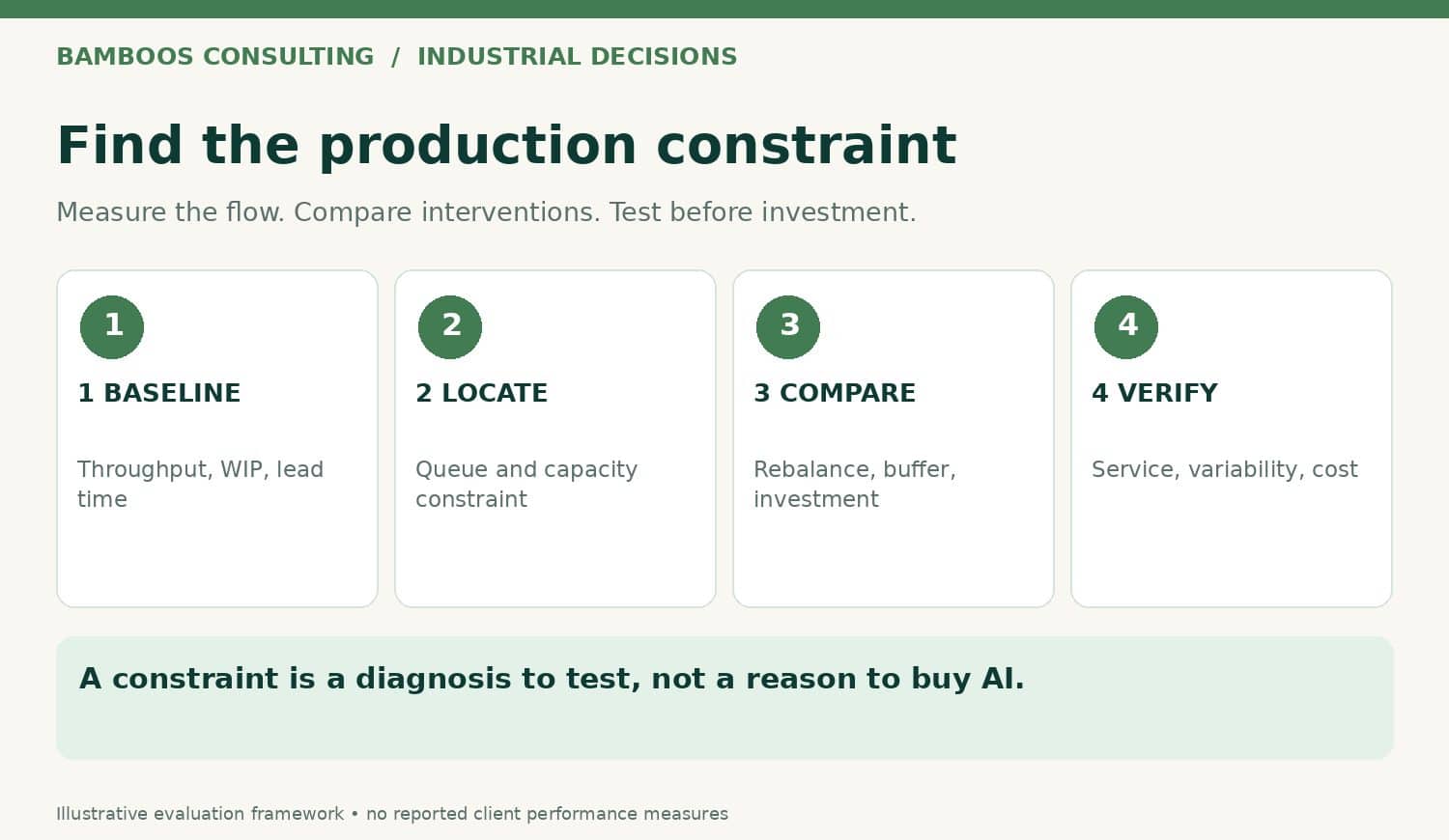
First, a scheduling or workload-rebalancing intervention can redistribute work or change release rules without adding equipment. Second, a targeted capacity intervention may reduce setup time, change shift allocation, or add capacity at the actual limiting stage. Third, data-driven prediction or optimization may improve release decisions when variable arrivals, durations, or disruptions make simple rules insufficient. These are alternative hypotheses, not a hierarchy in which artificial intelligence necessarily wins.
A simulation can represent arrivals, operations, resources, queues, failures, and dispatch rules. Run the current procedure and each alternative under the same scenario set. Vary demand, product mix, repair duration, staffing and data quality. Record both central outcomes and adverse cases. If a simulation is built with assumed rather than independently checked distributions, its results establish model behavior—not operational gains.
What would count as sufficient evidence?
Predefine a bounded improvement target such as reducing the 90th-percentile order lead time while maintaining quality and service. Report implementation cost, maintenance burden, human workload, and any new failure modes. Compare the proposed AI intervention with simpler dispatch rules and operational changes on held-out periods or scenarios. The acceptance decision should identify the remaining conditions requiring a field pilot.
An industrially relevant next step
For equipment manufacturers and SMEs in Piemonte and Lombardia, this analysis is a useful way to decide whether a problem warrants an industrial AI project, process redesign, simulation, or a narrower control change. The same evaluation logic applies to inspection cells and internal logistics. The European Commission JRC reports that AI uptake in manufacturing is not equivalent to integration into core production; technology selection should follow the specific process need rather than adoption statistics.
The earlier six industrial machine-learning business cases article surveys related applications. This article focuses specifically on the evidence needed to choose and test a capacity intervention. See also Technical Resources for evaluation methods.
Discuss Production-Flow Evidence
Define data, baseline, and alternative interventions
We can examine the process data, operating constraints, and candidate interventions, then define a reproducible assessment of the alternatives before committing to an implementation.
Explore Technical Resources, Machine Learning and Optimization, and Substack analysis.