E-Flow Warehouse Management Software
E-Flow is an example of software engineering grounded in direct operational management. Developed and deployed as a modular warehouse-management and distribution-logistics system, it supported an editorial-products distribution environment in which inventory, order fulfillment, deliveries, returns, reseller accounts, and financial reconciliation were closely connected. The system illustrates a practical approach to digital transformation: understanding operating constraints and information flows before designing or integrating software.
The underlying distribution-business experience extended well beyond software development. Over more than 15 years in operational and financial management, the work involved national distributors and publishing groups, independent retailers, organized retail accounts, logistics providers, and internal administrative teams. E-Flow formed part of this wider program of process redesign, information integration, and operating control.
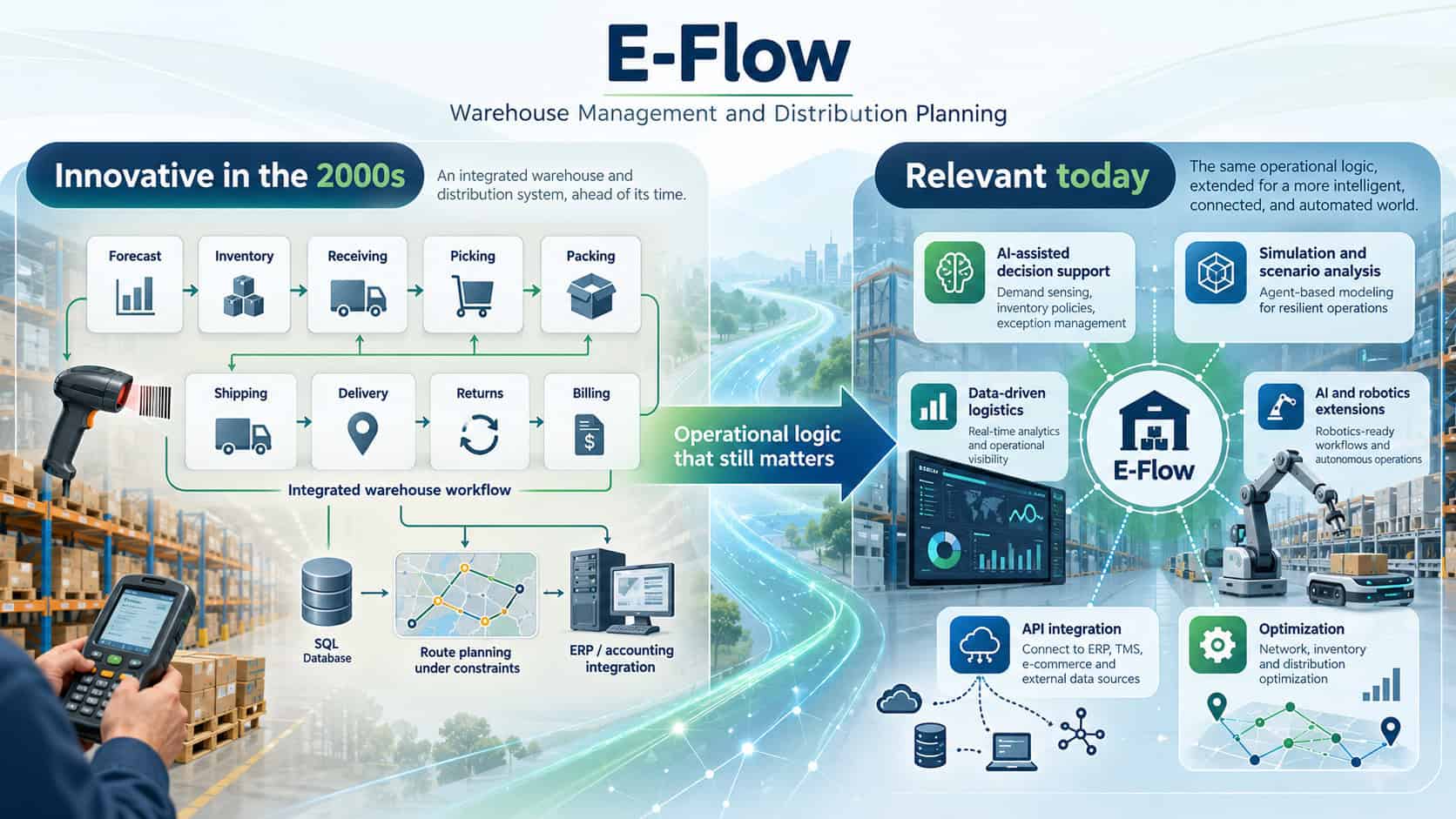
Production deployment and operating scale
E-Flow was deployed and used in warehouse operations that handled approximately 20 million individual items per year, with those items tracked by the warehouse-management system. The goods passing through the warehouse represented approximately €14 million in total purchase value. This is the purchase value of handled goods, not the business’s revenue, software-generated revenue, or a measured financial benefit of E-Flow.
The wider distribution business served a network of approximately 140 independent reseller counterparties, including newsstands, local retailers, and organized retail accounts. These were separate commercial businesses or retail accounts, not employees or warehouse users. Management responsibilities included customer-level profitability, route and service costs, deliveries and returns, weekly supply statements, outstanding balances, payment behavior, and credit exposure.
At the business level, financial management also covered approximately €12.5 million in annual payment flows and supplier cycles. This measures payments and financial administration; it should not be added to, or equated with, the €14 million purchase value of goods handled by the warehouse.
Operational and commercial results in the wider distribution business
The practical importance of this work was not limited to handling products more systematically. Management initiatives combined workflow redesign, ERP-based accounting and warehouse automation, commercial development, customer controls, supplier coordination, and financial reporting. Historical results from the broader distribution and systems-transformation activities include:
| Reported result | Scope and interpretation |
|---|---|
| Approximately 65% reduction in operating costs | Reported outcome of the broader reengineering and redesign of logistics and finance operations; not an isolated E-Flow software effect. |
| Approximately 15% revenue growth | Supported by commercial discipline, trade-marketing initiatives, operational reliability, and margin control across the distribution business; not measured as software-generated revenue. |
| Approximately 30–40% improvement in data accuracy | Associated with ERP-based accounting and warehouse automation, process redesign, and systems integration; not an E-Flow-only comparative test. |
| Approximately 140 independent reseller accounts monitored | Business-level monitoring of turnover, profitability, returns, payment reliability, receivables, and service requirements. |
These figures are historical management results and estimates relating to the wider business and its transformation activities. They describe different measures, scopes, and interventions; they are not outputs of a controlled evaluation attributing performance improvements to E-Flow alone. They nevertheless show the operating context in which warehouse software, accounting integration, commercial decisions, and process redesign were jointly managed.
The business problem: coordinating a high-frequency distribution network
The distribution business handled daily newspapers, magazines, books, collectibles, supplements, gadgets, and bundled editorial products. Many goods had short selling periods and substantial reverse-logistics requirements: products were delivered to retailers, sold or left unsold, collected where appropriate, recorded as returns, and reconciled with subsequent payments and credits. A high number of relatively small retail accounts made accurate, timely information important to both service continuity and financial control.
Operational decisions were interconnected. Allocation to a retailer affected shelf availability, delivery loads, expected returns, and working-capital exposure. Delivery routes were constrained by vehicle capacity, preparation time, customer requirements, and collection duties. Reconciliation required the business to connect stock issued, goods returned, account statements, credit adjustments, and receipts. The operational objective was therefore not simply to move goods efficiently, but to maintain a consistent record across the full commercial cycle.
What management and digitalization addressed together
- Retailer and key-account operations: Managing service conditions, turnover, returns, cost-to-serve, shelf productivity, and operating requirements across approximately 140 independent counterparties, including organized retail.
- Supply and reverse logistics: Coordinating national distributors, publishing groups, local delivery operations, and the collection and accounting of unsold products.
- Finance and credit control: Monitoring weekly statements, outstanding balances, delays, reconciliation discrepancies, and customer-level working-capital risk.
- Process and information integration: Replacing fragmented records and manual handoffs, where appropriate, with structured workflows, ERP links, reporting, and warehouse automation.
- Commercial and managerial decisions: Relating service reliability and product performance to customer profitability, trade marketing, margins, and cash conversion.
The significance of E-Flow is best understood within this operating environment. Software provided structure and traceability to parts of the workflow, while managers remained responsible for customers, suppliers, exceptions, credit decisions, and business performance.
A simple operating example
Consider a regional distributor supplying several retailers with products that have limited selling periods. Each retailer receives allocations, may return unsold units, and periodically settles its account. A delivery plan must reflect available stock, vehicle and loading constraints, and expected collections. A reliable weekly statement must then reconcile the goods supplied, returned units, credits, and payments. An integrated workflow can make discrepancies easier to identify, but the appropriate allocation or credit decision still depends on business rules and managerial judgment. This simplified example illustrates the operating logic; it is not a reconstruction of a measured E-Flow performance experiment.
E-Flow: functional modules and workflow support
E-Flow was designed as a modular system. The following descriptions summarize its documented functional scope; the configuration and degree of integration could vary with the operating environment and should not be read as proof that every module was deployed identically in every setting.
| Module | Function in the operating workflow |
|---|---|
| Forecast | Use historical sales or demand data to support operational estimates and capacity planning. |
| Inventory | Maintain item quantities, locations, stock movements, and physical or cycle-count records. |
| Receiving | Record inbound items, support identification and storage assignment, and connect receipts to stock records. |
| Picking | Organize order preparation and provide controls for picking accuracy. |
| Packing | Check prepared orders and packaging before dispatch. |
| Shipping | Validate shipment records, generate documentation, and exchange shipping data with administrative systems. |
| Delivery | Support planning of multidrop deliveries and collections under declared operating constraints. |
| Returns | Record, identify, sort, and trace returned items, including reverse-logistics flows. |
| Billing | Support invoicing, customer-account controls, reporting, and reconciliation of commercial transactions. |
Constraints considered in logistics planning
- Demand and orders: Quantities by customer, delivery point, product, or product category, based on forecasts or confirmed orders.
- Vehicles and loads: Vehicle dimensions, compartment capacity, packaged or bulk materials, and compatibility requirements.
- Delivery and collection: Customer time windows, docking restrictions, priorities, multidrop sequences, and reverse-logistics requirements.
- Warehouse capacity: Picking and loading resources, dock availability, floor space, and storage limitations.
- Product and inventory conditions: Stock availability, replenishment requirements, rotation, and shelf-life restrictions where relevant.
- Tracking and coordination: Vehicle-position data when compatible GPS or in-cab systems are available.
These variables form a constrained planning problem. A route with fewer kilometers, for example, may be unsuitable if a vehicle exceeds its available capacity or a retailer’s service window cannot be met. The objective and appropriate planning method depend on the actual operating rules and available data.
System architecture and integration
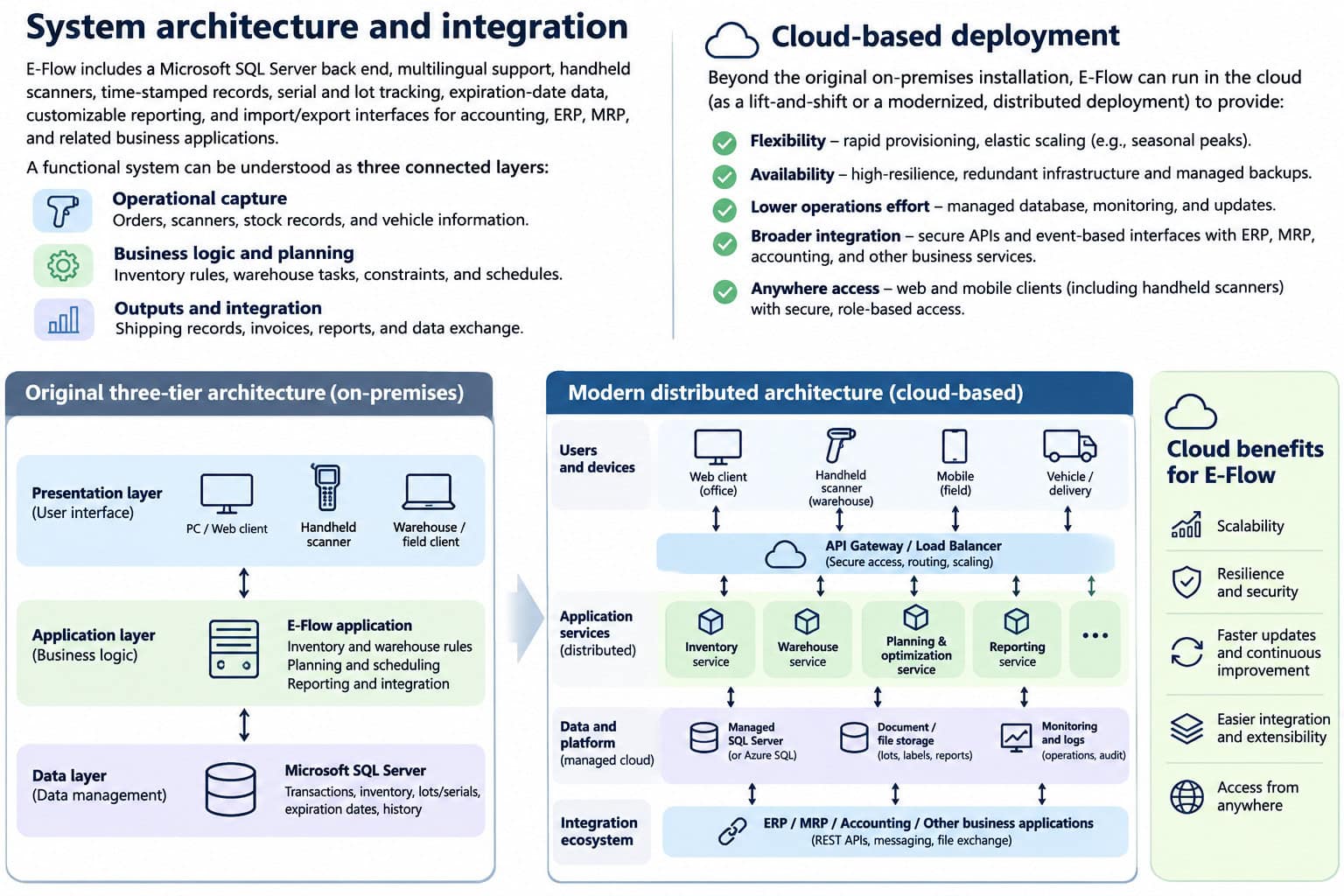
The documented E-Flow technology includes a Microsoft SQL Server back end, multilingual support, handheld scanning, time-stamped records, serial and lot tracking, expiration-date information, customizable reports, and data exchange with accounting, ERP, MRP, or other business applications. These features supported a modular approach to operational records and application integration.
A functional architecture can be understood as three connected layers: operational capture (orders, scanners, stock movements, and deliveries); business rules and planning (inventory controls, warehouse tasks, resource constraints, and schedules); and output and integration (shipping documentation, returns, billing records, reporting, and data exchange). This is a conceptual description of the system’s functions, not a claim that subsequent research systems formed part of its original implementation.
From operational experience to computational research
More than 15 years of direct responsibility for distribution and supply-chain operations created a practical basis for examining allocation, routing, working capital, and system behavior as connected decision problems. Later research explores these questions through agent-based models, simulation-based verification, and computational optimization. These studies are distinct from the historical E-Flow deployment: they do not imply that experimental AI or quantum methods were implemented in the original warehouse-management software.
1. Agent-based simulation of distribution networks
Allocating more stock to one retailer may improve availability locally while increasing shortages elsewhere, altering returns, or changing vehicle requirements. Agent-based modeling represents the interactions among retailers, distributors, decision rules, and shared resources rather than evaluating each actor independently.
Bounded Agentic Distribution Experiments (Zenodo, 2026) supplies a reproducible framework and a stylized print-media distribution simulator for comparing agent-proposed operational interventions with non-agentic search under common budgets and constraints. The published release is a pre-pilot computational protocol. Its automated tests establish implementation and protocol consistency; they do not establish an empirical performance advantage for AI agents or validate the simulator as a replica of an actual distribution company.
2. Simulation-based verification of inventory decisions
Inventory decisions must balance availability, replenishment capacity, working capital, and stability. An intervention that reduces one type of failure may still create unacceptable volatility or violate other limits. Simulation allows alternative rules to be tested against declared acceptance conditions before any operational adoption is contemplated.
Simulation-Based Verification and Bounded Repair of Adaptive Inventory Controllers (ECP 2026) examines finite inventory decision rules under stochastic demand. It tests whether diagnosed failures can be repaired and whether changes remain acceptable on held-out simulations. The experiments include improvements in individual metrics that do not satisfy the overall acceptance criteria. The related methodological preprint is Verification of Adaptive Agentic Controllers through Finite Rule Revision.
3. Quantum and classical optimization for inventory allocation
Allocation and replenishment decisions can be formulated as constrained optimization problems. Ongoing work titled Beyond Exact Recovery: Operational Success Probability and Sampling Cost for Approximate Quantum Optimization under Stochastic Uncertainty studies a small inventory-control problem using a quadratic unconstrained binary optimization (QUBO) formulation, the Quantum Approximate Optimization Algorithm (QAOA), and classical reference methods.
The Research Square preprint (version 1) examines the distinction between recovering an exact mathematical solution and obtaining a decision that meets operational acceptance criteria under uncertainty. This is computational and simulation research, not verified production use, a claim of quantum advantage, or a feature of the historical E-Flow system.
How operational systems and research complement one another
A deployed warehouse-management system records and coordinates actual transactions. Simulation can compare alternative operating rules under stated assumptions, while optimization methods can be evaluated for selected allocation or scheduling problems. Each layer requires its own data, implementation tests, and evidence of fitness for use. Together, these capabilities inform operations and software consulting and AI Consulting & Computational Systems.
Discuss an Operations or Systems Project
E-Flow illustrates how operational management experience can inform software architecture and data integration. The broader distribution-business work adds experience in customer and supplier relationships, financial controls, route-based services, reverse logistics, and the management of independent reseller networks. These are relevant to SMEs seeking to modernize legacy workflows without separating software requirements from the commercial and financial consequences of operational decisions.
A contemporary assignment might assess warehouse-data reliability, ERP/WMS integration, customer and route economics, returns reconciliation, forecasting feasibility, simulation of allocation policies, or AI-assisted exception handling.
How an engagement would begin
- Map operational and financial workflows: Identify orders, inventory, returns, account statements, payments, exceptions, actors, and handoffs.
- Identify decision and service constraints: Clarify service requirements, routing or stocking objectives, customer economics, credit exposures, and available measurements.
- Review integration and data quality: Examine WMS, ERP, scanners, accounting records, reporting interfaces, and legacy-system limitations.
- Define a bounded assessment: Distinguish process changes, configuration, conventional software integration, simulation, AI development, and further research according to the evidence needed.
The objective is to identify a feasible next step with documented requirements and outcomes, rather than assume that a particular technology is appropriate before examining the operation. For the broader technical approach, see AI Consulting & Computational Systems.