Industrial AI After ECP 2026: Three Operational Decisions to Evaluate
Research on infrastructure maintenance, process monitoring, and inventory control illustrates how companies can evaluate AI against operating decisions rather than technical scores alone.
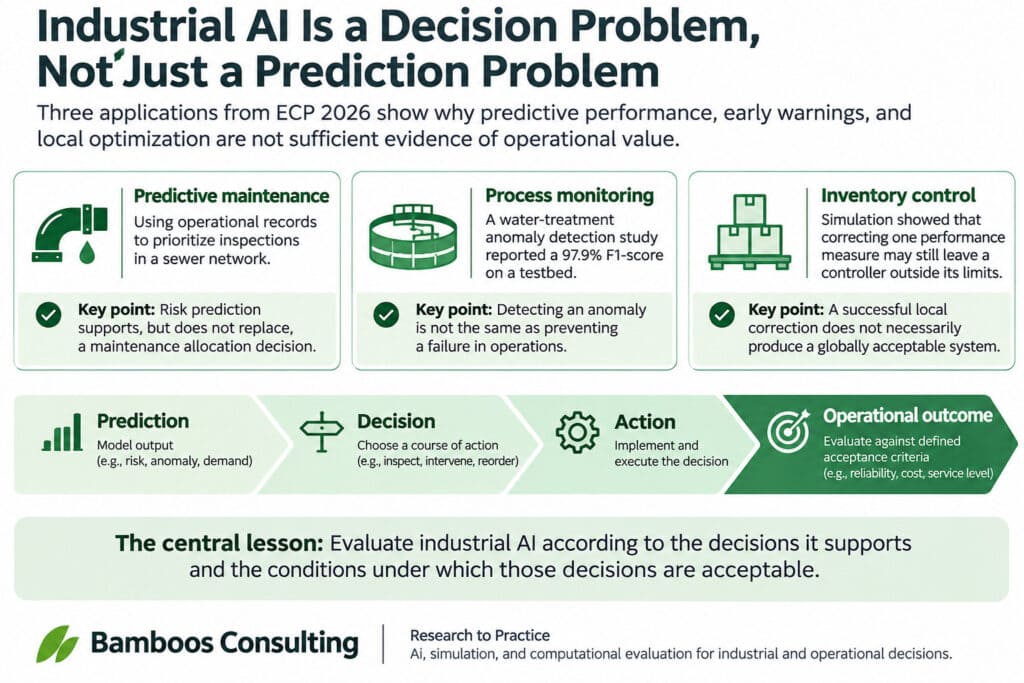
The 5th International Electronic Conference on Processes (ECP 2026), held October 20–22, 2026, featured research relevant to industrial operations. The value of such work for companies is not that a new algorithm necessarily performs better in practice. It is that specific experiments and proposed methods help clarify which decisions an AI system might support—and which tests are required before relying on it.
Three contributions provide useful examples across utilities, process operations, and inventory management. They represent different levels of evidence: a proposed decision-support approach using utility records, an anomaly-detection evaluation on a water-treatment testbed, and experiments in a stylized inventory simulation. None establishes a measured commercial improvement after full industrial deployment.
1. Which infrastructure assets should be inspected first?
Inspection crews and maintenance budgets are limited. Operators of water and wastewater networks must therefore decide which assets deserve attention before failures occur. An AI-supported system is valuable only if it improves this allocation relative to available practices.
Pietrucha-Urbanik and Kosiorowska presented an approach for screening urban sewer failure risk using municipal utility records. Information such as pipe characteristics, reported failures, and maintenance history can be organized to identify sections that warrant further inspection. The work is presented as decision support rather than a substitute for engineers or a validated autonomous maintenance system.
Possible industrial application: Ranking inspection candidates for a constrained maintenance program. The acceptance test would compare the proposed ranking with existing practice, the cost of unnecessary inspections, the consequences of missed failures, and the quality of historical records.
Its business value remains a question for field evaluation; the conference abstract does not establish a measured reduction in maintenance expenditures.
2. When should an abnormal process signal trigger intervention?
Industrial plants increasingly generate multivariate streams from sensors and actuators. Detecting a change in those signals is technically different from deciding whether to intervene. A useful warning must arrive with enough lead time to respond, while keeping the cost of false alarms manageable.
Kumar and colleagues reported a Transformer Autoencoder evaluated on the Secure Water Treatment (SWaT) testbed. Their abstract reports a 97.9% F1-score for anomaly detection, 27% fewer false alarms than the conventional monitoring methods used in their comparison, and alerts 8–12 minutes before critical threshold violations under the evaluated conditions.
These are reported testbed outcomes. They should not be interpreted as guaranteed results in an operating water-treatment facility, where sensors, failure modes, operator procedures, and economic consequences differ.
Possible industrial application: Supporting process operators with earlier alerts. A deployment study should examine false alarms per shift, missed events, detection-to-action delay, and whether interventions produce measurable operational benefits.
3. When is an automated inventory rule acceptable?
Inventory control involves several requirements at once: service quality, replenishment capacity, working capital, budget constraints, and the stability of orders. Improving one measure does not guarantee that an automated policy is fit for operational use.
My ECP 2026 contribution, Simulation-Based Verification and Bounded Repair of Adaptive Inventory Controllers, examined finite-rule inventory controllers under stochastic demand. The study used an eight-unit, 120-period stylized simulation with explicit guardrails. Candidate edits were diagnosed on five simulation seeds and evaluated on twenty held-out seeds.
In one experiment, removing an order-smoothing rule increased held-out order volatility to 20.62. Adding a corrective smoothing rule reduced that statistic to 11.46, below the declared threshold of 12.00. However, stockout rate and tracking error still violated their limits. The modification succeeded locally but the controller was rejected under the full acceptance test.
Possible industrial application: Testing revised replenishment rules before introducing them into a warehouse or purchasing process. The simulation demonstrates a verification protocol; it does not establish controller optimality or deployment-domain validity.
4. One framework for three different operating decisions
These contributions can be compared without treating them as the same technology. Each begins with a different operating decision and therefore requires different acceptance evidence.
| Research application | Decision supported | Evaluation required |
|---|---|---|
| Sewer network screening | Which sections to inspect first | Risk ranking, missed failures, inspection capacity and cost |
| Water-treatment monitoring | When an alert warrants intervention | Detection delay, false alarms, response time and operating context |
| Inventory-controller revision | Whether a revised rule can be accepted | Joint thresholds for service, stability, capacity and working capital |
5. A practical starting point for smaller companies
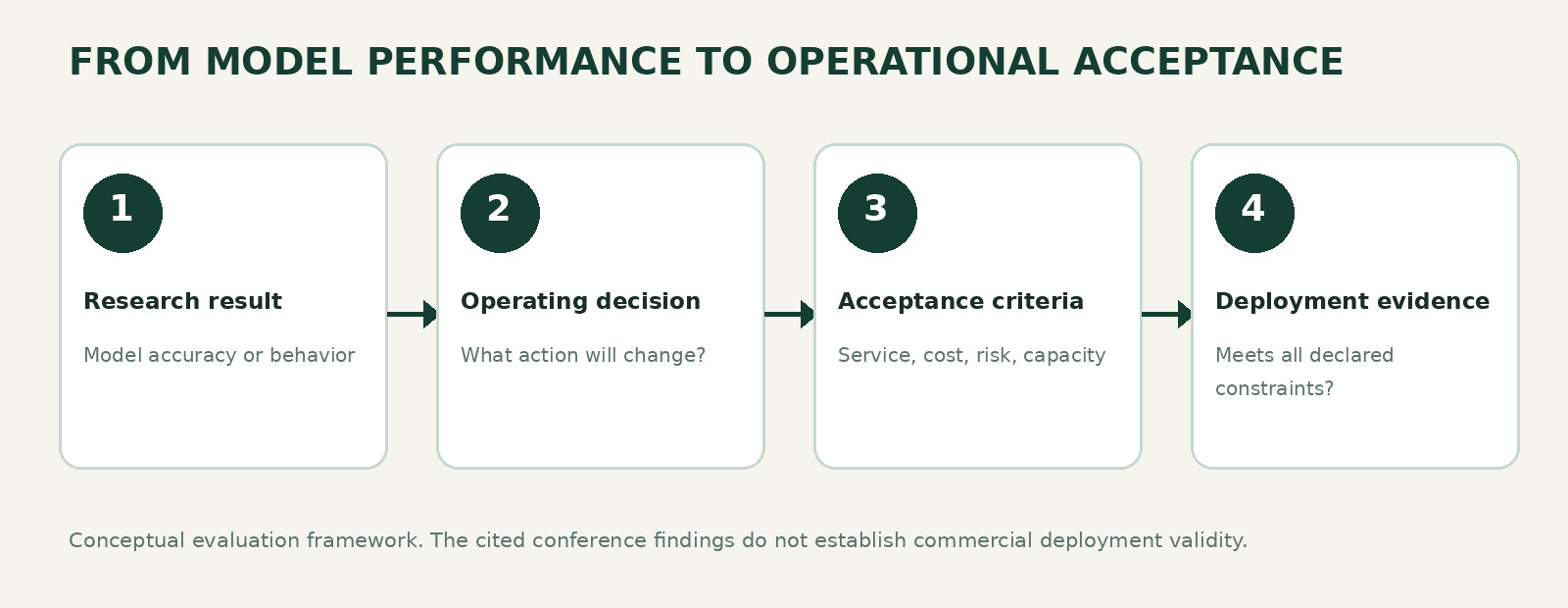
For a European SME, a narrowly defined evaluation is often more informative than starting with a general-purpose AI deployment. The initial project can focus on a single operating decision, a limited dataset, and explicit criteria for success or rejection.
- Define the action: What changes after an inspection ranking, anomaly alert, or inventory recommendation?
- Set the limits: What levels of missed events, false positives, cost, delays, or service failures are unacceptable?
- Test beyond the demonstration: Use separate evaluation data or simulation runs, document failure conditions, and confirm the result in the intended operating environment before wider use.
The goal is not to claim that research results are already deployable. It is to use research to design better questions, tests, and acceptance decisions.
Assess an Industrial AI Application Against Its Operating Constraints
Bamboos Consulting supports companies in assessing whether AI, machine learning, and simulation methods are appropriate for a concrete operational decision. A technical assessment can define the target decision, identify the available evidence, establish acceptance criteria, and determine which uncertainties require further testing before implementation. See our AI Consulting & Computational Systems service for related capabilities.
References
- Pietrucha-Urbanik, K., and Kosiorowska, U. (2026). AI-Assisted Failure Risk Screening for Urban Sewer Networks Based on Operational Utility Records. ECP 2026.
- Kumar, N., et al. (2026). Transformer Autoencoder-Based Anomaly Detection and Intelligent Process Monitoring for Smart Water Treatment Plants. ECP 2026.
- Garrone, R. (2026). Simulation-Based Verification and Bounded Repair of Adaptive Inventory Controllers. ECP 2026.
- 5th International Electronic Conference on Processes (ECP 2026), October 20–22, 2026.