

From current indicators to operational context
Coincident measures summarize different aspects of present economic conditions rather than provide a complete real-time view.
Align indicators by release date, definition, revision history, and relevant market before applying them to management reporting.
Coincident indicators are variables tracking the current state of the economy; thus, coincindent indicators are useful to understand the strength and resilience of current economic conditions. Specifically, such metrics are used in conjunction with leading and lagging indicators to get a full view of where the economy has been and how it is expected to change in the future.
Using the free series provided by the FRED database (series indicated in parenthesis), it is possible to replicate some of the most used coincident indicators of the Conference Board. The coincident indicators can be assigned a weight to facilitate the overall interpretation of each component. My free implementation includes:
- Volume of Total Retail Trade sales (SLRTTO01USQ661S)
- All Employees: Total Nonfarm Payrolls (PAYEMS)
- Personal Income (PI)
- Personal Consumption Expenditures (PCE)
- Federal government current transfer payments: Government social benefits: To persons (B087RC1Q027SBEA)
- Industrial Production Index (INDPRO)

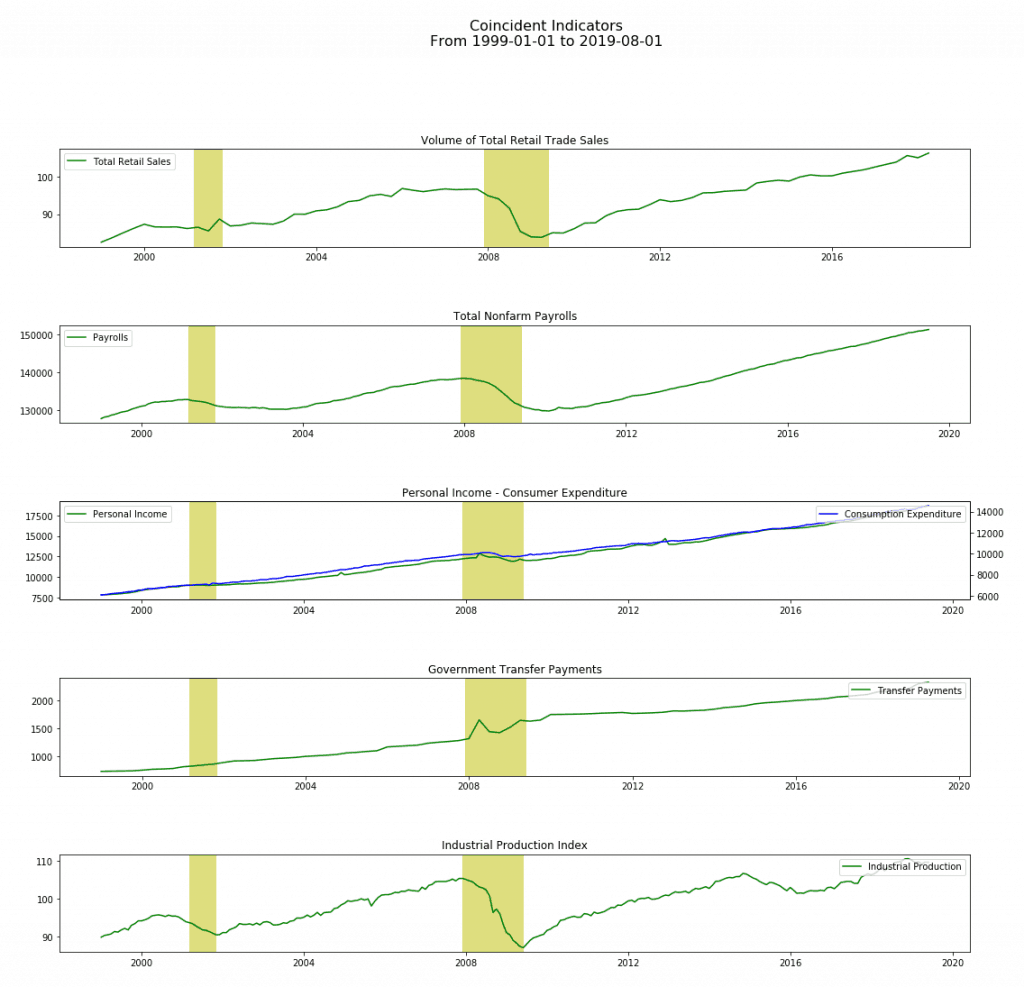
Volume of Total Retail Trade sales
In general, when retail sales are increasing, consumers and businesses optimism determines a positive impact on the present and future economy. Substantially, retail sales are a proxy for consumer and businesses willingness to spend. Weight: 53%.
Total Nonfarm Payrolls
Nonfarm payrolls is the number of workers in full, part-time, temporary or permanent position. Usually, when employment is rising, the economy is expected to expand or at least to maintain its positive trend. Weight: 27%.
Personal Income
A consumer-driven economy has a major contribution to GDP given by the ability of consumers to spend. Personal income is the main source of consumer spending. Weight: 13%.
Personal Consumption Expenditures
PCEs are the amount spent by consumers; usually, personal income and PCEs decrease during recessions
Federal government current transfer payments
Transfer payments are redistributions of tax revenue by the government, including Social Security, welfare, and business subsidies. Personal income minus transfer payments is the measure of income growth from the real economy, that is excluding state intervention. Transfer payments usually increase.
Industrial Production
Industrial production is thought to have a strong positive correlation with GDP; the index measures physical output in the manufacturing, mining, and gas and electric utility industries. Weight: 7%.
Applications and Business Cases
Business Monitoring with Coincident Measures. The following are analytical or illustrative use cases, not independently verified commercial deployments or measured improvements.
Sales and workforce monitoring
A service firm can evaluate whether current employment, income, and consumer spending statistics help interpret changes in bookings or sales. A dashboard must show release delays and revision status, not treat monthly indicators as contemporaneous operational measurements.
Sector exposure
A supplier can compare industrial production with internal order books across customer industries. Differences in geographic and sector composition limit direct inference from aggregate economic series.
Discuss an Economic Monitoring Project
Connect Economic Measures to Business Exposure
We can examine the reliability, delays, and relevance of employment, production, income, and spending data for operational reporting and scenario decisions.
See our Technical Resources and Substack for additional analysis. Research content is subject to our Terms of Use.
References and Further Reading
- Weigand (2012). Applied Equity Analysis and Portfolio Management