

Interpret heat transfer and solidification across the production cycle
A practical framework for connecting die-temperature histories, process inputs, and thermal scenario analysis in HPDC.
The engineering value comes from matching model assumptions to process measurements and evaluating outputs against the intended decision.
Computational thermal analysis can help engineering teams examine heat transfer, solidification, die-temperature histories, and cooling scenarios. The useful question is not simply whether a model can produce a temperature field, but whether its assumptions and inputs match the decision that the engineering team needs to make.
Why thermal behavior deserves a separate engineering view
High-pressure die casting (HPDC) is a repeated thermal process. Molten alloy enters a steel die, transfers heat across the casting–die interface, solidifies and cools, and is ejected. The die is then prepared for the next cycle through cooling, lubrication, and other process steps. The thermal state therefore evolves over successive cycles rather than being defined by one isolated casting event.
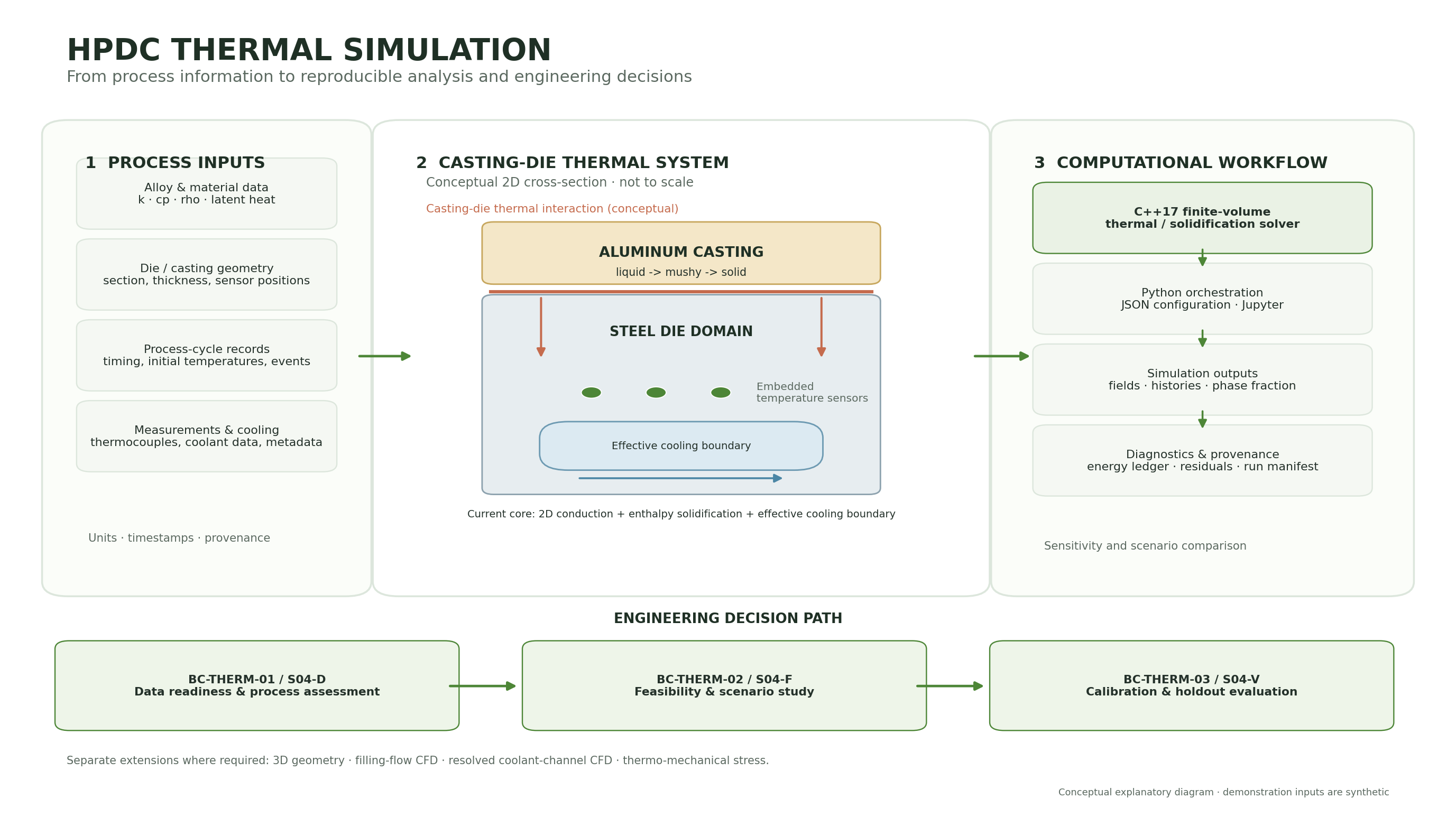
Several mechanisms interact: heat conduction through the casting and die; latent heat released during solidification; transient thermal contact between the casting and die; heat extraction through cooling channels and other boundary conditions; and die preheating, cycle timing, spray/cooling phases, and operating variation.
These mechanisms influence temperature histories and the thermal conditions under which solidification takes place. They are relevant to process engineering, die design, cooling-system assessment, and the interpretation of temperature measurements.
The engineering challenge is that important boundary conditions are not always directly measurable at the metal–die interface. Temperature sensors are commonly installed within the die at known depths, and interface heat flux or heat-transfer coefficients may then be inferred from the measured histories. The quality of a simulation depends on how well these boundary conditions, material properties, and process phases represent the actual system.
What published HPDC studies show
Research on instrumented dies demonstrates why measured temperature histories matter.
Dour and colleagues developed a non-intrusive heat-transfer gauge using multiple thermocouples in an H13 die and optical measurement of casting-surface temperature. Their production-tool study included 150 castings under varied process parameters. The authors identified piston velocity and initial die temperature among the parameters with substantial influence on heat-transfer conditions. The study illustrates the value of linking process settings to measured thermal response rather than relying on a single generic boundary coefficient (Dour et al., 2005).
Long and colleagues examined the metal–die heat-transfer coefficient for high-pressure die-cast AlSi9Cu3Fe. Temperature histories from instrumented production dies were compared with simulation outputs. The default interface heat-transfer assumptions produced a poor correlation in the first comparison; the authors adjusted the interface condition and then evaluated it against a second instrumented die. The work demonstrates that interface assumptions can materially affect the thermal response and that a calibration exercise should be tested beyond the data used to tune it (Long et al., 2011).
More recently, Teamah et al. reported an instrumented hot-chamber die-casting apparatus designed to reproduce relevant HPDC thermal conditions. Their A365/H13 setup used nine embedded die thermocouple channels at three depths across three cavity sections. The study compared inverse-estimated heat-flux histories from the laboratory apparatus with an industrial HPDC trial. The reported peak heat-flux difference was approximately 14%, while the full width at half maximum differed by less than 12%. These are results for that particular experimental comparison, not universal tolerances for other alloys, dies, or processes (Teamah et al., 2025).
Cooling-channel conditions also require attention. Bohacek et al. used multiple temperature measurements and an inverse heat-conduction method to estimate transient heat-transfer conditions along a die insert. Their results indicate that the cooling-channel boundary can vary spatially, reinforcing the need to represent cooling conditions in a way that is appropriate to the geometry and measurement locations (Bohacek et al., 2024).
For repeated production cycles, Kunz, Strelow, and Beckmann describe periodic thermal patterns in HPDC dies and compare a simplified dynamic thermal model with experimental data. Their work is relevant to the distinction between a single-cycle transient and the longer-term cyclic temperature response of the tool (Kunz et al., 2014).
Taken together, these studies point to a practical engineering sequence: identify the thermal question, establish the data and boundary-condition basis, compare a model with measured histories, and reserve independent operating cycles for evaluation.
From process records to a useful thermal model
A useful study begins with a data package, not with a preferred solver setting. The required information depends on the intended question, but commonly includes:
| Information | Examples | Why it matters |
|---|---|---|
| Geometry | Die/cavity cross-section, insert dimensions, sensor positions | Defines the modeled heat-flow domain and observation locations |
| Materials | Alloy and die grades; density, heat capacity, conductivity, solidus/liquidus range, latent heat | Governs heat storage, conduction, and phase change |
| Process sequence | Injection/contact, solidification, ejection, cooling/spray, cycle timing | Defines transient boundary conditions and repeated-cycle structure |
| Temperature data | Thermocouple histories, sensor type, coordinates, calibration, sampling interval, uncertainty | Supports comparison at actual measurement locations |
| Cooling data | Inlet/outlet temperature, flow, pressure, channel or insert description | Helps define the effective cooling boundary |
| Context | Cycle identifiers, machine settings, operating changes, data provenance | Distinguishes representative conditions and supports independent evaluation |
Units, timestamps, sensor coordinates, and cycle identifiers are as important as the temperature values themselves. A temperature series without a reliable time base or sensor position may be unsuitable for a quantitative comparison.
The HPDC-Twin computational approach
Bamboos Consulting has developed HPDC-Twin as a C++17 thermal and solidification research prototype connected to a Python/Jupyter workbench. The current research line uses a two-dimensional finite-volume formulation with enthalpy-based treatment of phase change. The Python layer configures and orchestrates the compiled solver, reads its outputs, and supports visualization and diagnostics; it does not implement a separate thermal solver.
The demonstrated workflow includes configuration through structured JSON inputs; execution of the C++ thermal solver; export of simulation summaries and optional spatial fields; inspection of temperature and phase-fraction fields; multi-cycle scenario runs; sensitivity analysis for selected uncertain parameters; and numerical diagnostics and run provenance.
The current demonstration has been exercised with a three-cycle synthetic telemetry scenario. It exports cell-centered temperature and phase-fraction fields, thermal summaries, solver diagnostics, and run metadata. This demonstrates the computational workflow and reproducibility of the software; the example parameters and telemetry are illustrative rather than measurements from an industrial die.
The current reference model is organized around two-dimensional heat conduction and enthalpy-based solidification, with an effective cooling-boundary representation. This provides a focused computational basis for examining thermal histories and comparing selected process scenarios. Where a project calls for greater geometric or multiphysics fidelity, additional work can be scoped around three-dimensional geometry, detailed cooling-channel representation, filling-flow analysis, or thermo-mechanical coupling.

Download the HPDC-Twin technical overview and demonstration note (PDF) for a concise description of the current prototype and its demonstration evidence.
Three ways to engage
Bamboos Consulting organizes the work as a staged engineering service.
BC-THERM-01 | Thermal Data-Readiness Gate (S04-D)
A paid assessment of the customer’s engineering question, geometry, materials, process sequence, sensor records, and cooling information. The output is a data inventory, model-applicability assessment, prioritized data plan, and a bounded proposal for further work. This is the appropriate starting point when the customer has a thermal question but has not yet assembled a model-ready data package.
BC-THERM-02 | Thermal Feasibility and Scenario Study (S04-F)
A customer-specific study using representative measured data and an agreed holdout design. Bamboos adapts the model to a bounded geometry and process question, runs a baseline and selected alternative conditions, examines sensitivity, and compares the model’s behavior with a development dataset. The holdout data remain reserved for independent evaluation. The study helps determine whether the selected model scope is useful for the question and whether a more formal calibration/validation pilot is justified.
BC-THERM-03 | Thermal Calibration and Independent Validation Pilot (S04-V)
A deeper engagement that calibrates selected parameters on designated cycles or operating conditions and evaluates the frozen model against independent holdout cycles or conditions. Metrics are agreed before calibration and may include temperature-history error, peak-temperature difference, time-to-peak, cooling-rate behavior, and cycle-to-cycle drift. The result is a documented assessment of model performance within a defined operating envelope, together with the data, assumptions, residuals, and recommendations needed for the next engineering decision.
Turning a simulation into an engineering decision
A temperature map is not, by itself, an engineering conclusion. The value of a thermal study comes from connecting the model outputs to a defined question and to the measurements and assumptions that support their interpretation.
For example, a study may compare how a selected effective cooling boundary changes a modeled die-temperature history, or examine how uncertainty in an interface parameter affects a solidification-related output. The engineering team can then decide whether the scenario is worth testing, whether additional instrumentation is required, or whether a higher-fidelity model is needed.
The same principle applies to calibration. Parameters should be estimated on a designated calibration dataset and evaluated on separate cycles or operating conditions. Randomly splitting adjacent time samples can create leakage because neighboring measurements are strongly related in time. Holding out complete cycles or operating conditions gives a more meaningful test of how the model behaves beyond the data used to tune it.
Discuss a thermal engineering question
Connect the engineering decision to the process evidence and model scope.
Bamboos Consulting works with manufacturing and engineering teams to structure thermal-analysis requirements, organize process data, and develop bounded simulation studies. An initial discussion can identify the relevant thermal question, review the information already available, and define a practical first engagement.
For a concise description of the computational workflow, see the HPDC-Twin technical overview and demonstration report. Explore Machine Learning and Optimization and AI Consulting and Computational Systems.
References
- Dour, G., Dargusch, M., Davidson, C., & Nef, A. (2005). Development of a non-intrusive heat transfer coefficient gauge and its application to high pressure die casting: Effect of the process parameters. Journal of Materials Processing Technology, 169(2), 223–233. https://doi.org/10.1016/j.jmatprotec.2005.03.026
- Long, A., Thornhill, D., Armstrong, C. G., & Watson, D. (2011). Determination of the heat transfer coefficient at the metal–die interface for high pressure die cast AlSi9Cu3Fe. Applied Thermal Engineering, 31, 3996–4006. https://doi.org/10.1016/j.applthermaleng.2011.07.052
- Teamah, Abdelfatah M., Ahmed M. Teamah, Mohamed S. Hamed, & Sumanth Shankar. (2025). Experimental and Numerical Replication of Thermal Conditions in High-Pressure Die-Casting Process. Processes, 13(12), 3815. https://doi.org/10.3390/pr13123815
- Bohacek, J., Mraz, K., Hvozda, J., Lang, F., Raudensky, M., Vakhrushev, A., Karimi Sibaki, E., & Kharicha, A. (2024). Determination of transient heat transfer by cooling channel in high-pressure die casting using inverse method. Journal of Physics: Conference Series, 2766, 012197. https://doi.org/10.1088/1742-6596/2766/1/012197
- Kunz, G., Strelow, O., & Beckmann, M. (2014). Dynamic modeling of fluid-cooled tools in periodic thermal processes. International Journal of Thermal Sciences, 84, 228–251. https://doi.org/10.1016/j.ijthermalsci.2014.05.011