

Four Technical Resources: What Their Evidence Can Establish
New technical material is useful only when its evidentiary status is clear. A reproducible test can establish how selected functions behave under specified inputs; an evaluation protocol can define what should be measured; a reference architecture can clarify interfaces and controls. These are different contributions. None, in isolation, demonstrates that a system is reliable in production.
The Bamboos Consulting Technical Resources library now provides four technical articles with accompanying material on agentic workflows, robotics, edge intelligence, and industrial visual inspection. Their common purpose is to connect a concrete engineering decision to the evidence that would support it.
Four resources, four evidence boundaries

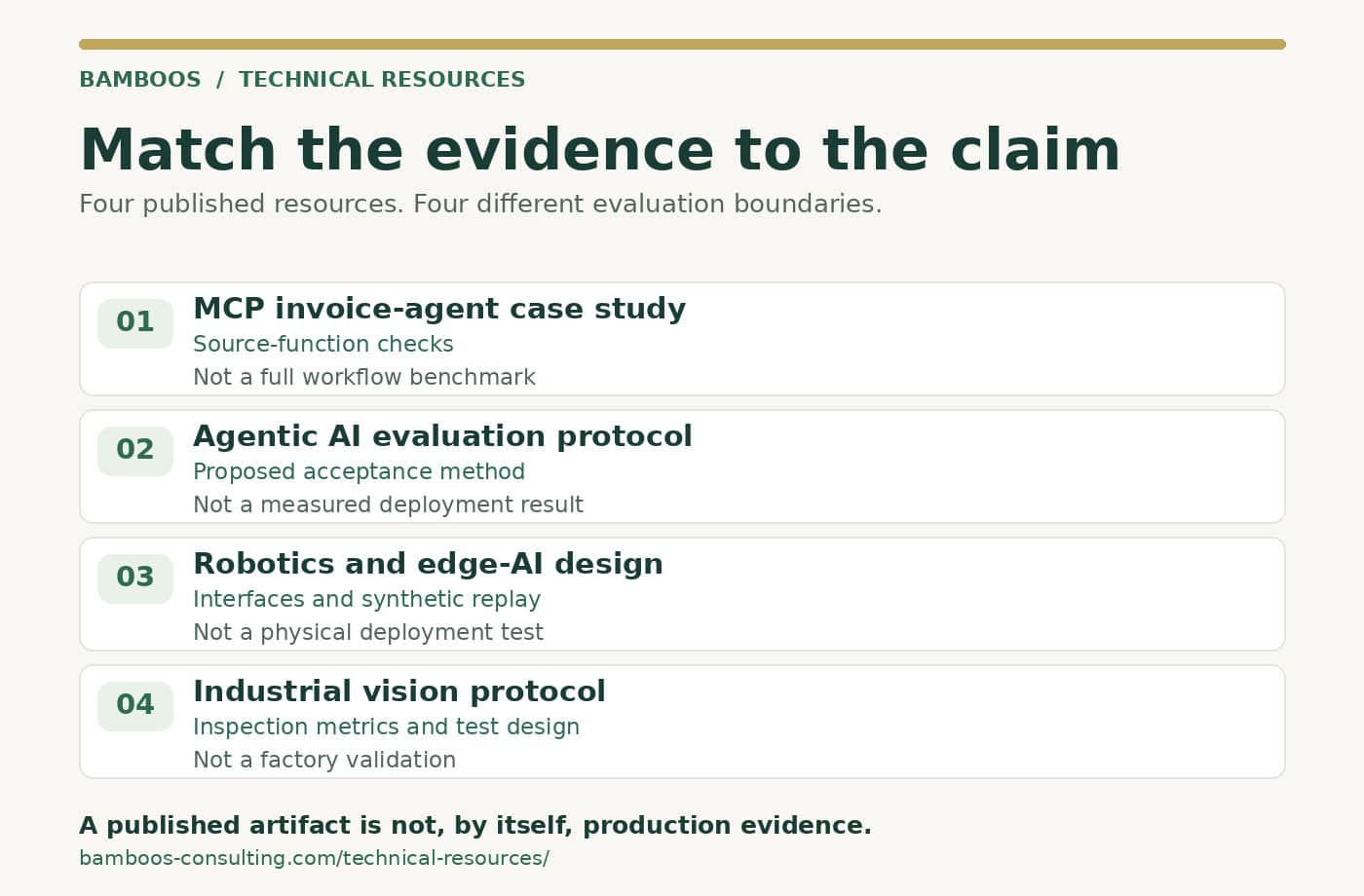
| Resource | What is available | What remains unverified |
|---|---|---|
| MCP Invoice-Agent Source-Level Case Study | Recorded checks of specified synthetic invoice functions and state changes | Complete LangGraph execution, live MCP transport, and authenticated production approvals |
| Agentic AI Evaluation Protocol | A proposed method covering expected actions, authorization, traces, failures, and release criteria | Measured reliability of any particular deployed agent |
| Robotics and Edge AI Reference Architecture | An interface-oriented design and selected synthetic replay tests | Physical robotic operation, device-specific inference measurements, and safety certification |
| Industrial Computer Vision Evaluation Protocol | Methods for defining missed-defect rates, false alarms, data splits, robustness, and latency | Demonstrated performance in a specific production line or camera environment |
How to use these materials in a feasibility assessment
Consider a company evaluating automated inspection or a tool-enabled service workflow. The first step is not to select an AI model. It is to identify the operational event that matters: a wrong inventory update, an unauthorized refund, a missed defect, or a delayed inference that prevents a timely decision. The next step is to specify what should be observed and what would count as an unacceptable outcome.
For an invoice workflow, a fluent final message cannot substitute for inspecting the actual tool call, its authorization context, and the before-and-after record state. Source-level tests can examine selected functions, but workflow orchestration, transport failures, and independent authorization require separate tests. The invoice-agent case study documents that boundary directly.
For a visual inspection system, the corresponding evidence includes defect-level false negatives, false-alarm frequency, acquisition conditions, inference latency, and the cost of escalation. A model accuracy figure from a convenient dataset cannot establish these outcomes in a new factory. The computer vision protocol describes how a test should be structured, while the robotics and edge-AI architecture separates perception, decision supervision, and any subsequent physical action.
The agentic AI evaluation protocol offers a common way to record accepted behaviors, prohibited actions, negative cases, traces, and unresolved evidence. A useful result is not necessarily a single performance percentage. It may be a documented pass, fail, or inconclusive finding under a declared test scope.
A practical evidence register
For each technical claim, record the version and source of the artifact, the environment and test inputs, the expected observable outcome, the actual result, and the cases not executed. Keep design hypotheses separate from measurements. A passing synthetic check is evidence about that check; an unexecuted end-to-end test remains unexecuted. This discipline helps technical teams decide what to build or evaluate next without treating a diagram, a demonstration, and an operational trial as interchangeable.
Discuss an Evidence-Based Technical Feasibility Study
If your organization is assessing an AI-enabled workflow, robotic subsystem, or computer vision application, Bamboos Consulting can help define the decision, establish an evaluation boundary, and specify the evidence needed before committing to implementation. Review the technical resources or explore our AI Consulting & Computational Systems services.
References and source material
- Bamboos Consulting, Technical Resources (accessed November 1, 2026).
- MCP Invoice-Agent Source-Level Case Study.
- Agentic AI Evaluation Protocol.
- Robotics and Edge AI Reference Architecture.
- Industrial Computer Vision Evaluation Protocol.
- NIST AI Risk Management Framework (general evaluation context; not certification of these artifacts).