

Technical Resources / Robotics and Edge Intelligence
Installing an inference model at the edge does not, on its own, demonstrate that a robotic application is reliable. The engineering question is whether a specified perception workload can be executed within a bounded time, produce interpretable outputs, and pass results through a separately supervised decision interface. This article describes an evaluation-oriented architecture intended for industrial feasibility studies, not a completed robotic deployment.
1. Define the application before choosing hardware
Consider a fixed-camera inspection cell. A camera captures items on a production line, an inference component estimates defect classes, and a downstream system decides whether to flag an item or request human review. This differs from autonomous robotic manipulation: inspection does not establish object localization, trajectory planning, or safe motion execution. A useful project specification therefore identifies the actual decision, the camera arrangement, the production cycle, and the consequences of missed and false detections before selecting a processor or runtime.
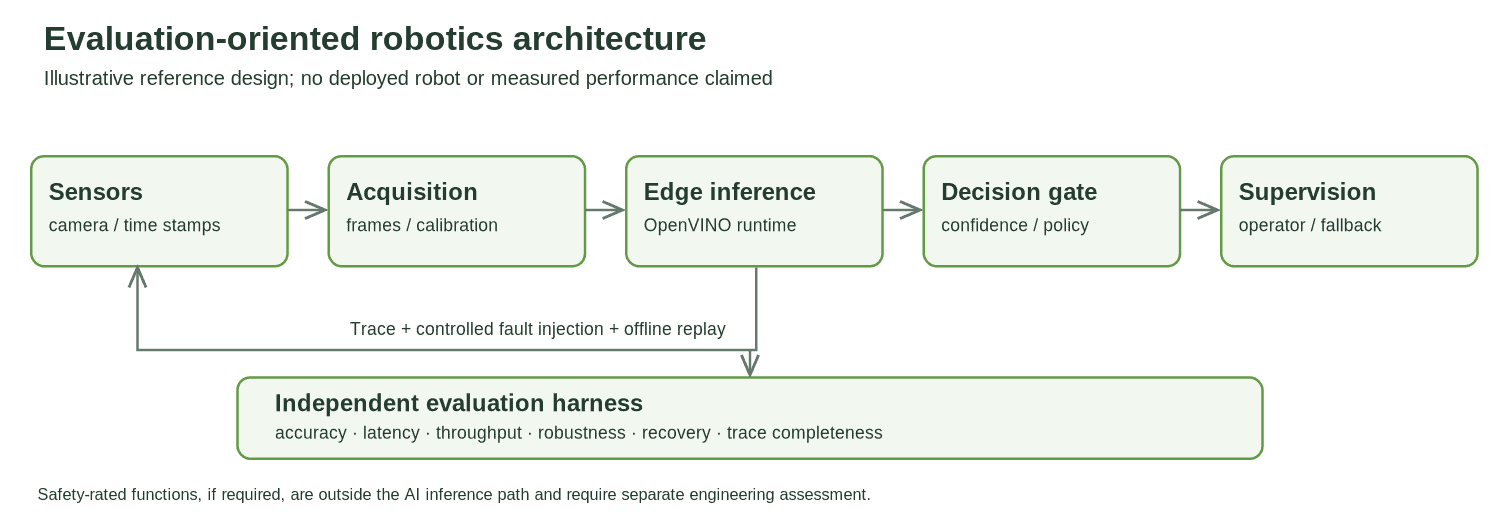
The reference architecture separates acquisition, preprocessing, inference, a policy gate, and supervision. It also includes an independent evaluation process so that evidence is collected at component interfaces. An AI classifier may produce a recommendation, but physical action, emergency stops, and safety-rated functions are outside the authority of that recommendation.

2. Specify observable interface contracts
A frame record should contain an identifier, timestamp, sensor information, calibration identifier, and integrity metadata. The inference response should include the model version, class scores, time spent, and an explicit timeout or error state. The decision gate should document which outputs are allowed, rejected, or escalated. Finally, an action request should carry an authorization context and an idempotency key where external state can change.
These distinctions matter because a high-confidence prediction obtained from a stale image is not a valid decision. Similarly, a timeout should not be silently converted to a negative inspection result. A trace must preserve the sequence from acquisition to final disposition so that failures can be reproduced or investigated.
3. Compare CPU and accelerated inference without changing the experiment
Intel OpenVINO provides one possible implementation path. To compare it with another runtime or device, hold the model weights, input resolution, preprocessing, batch size, evaluation dataset, and test policy constant where feasible. Record CPU or accelerator model, memory, operating system, OpenVINO version, execution provider, precision settings, warm-up policy, and concurrency. If model quantization or preprocessing differs, it becomes a different configuration and should be reported as such.
A single average inference time is insufficient. Report latency distributions, throughput under load, timeouts, dropped frames, recovery after restart, and the fraction of runs with complete traces. GPU and CPU results should not be described as operationally superior without considering the actual inspection cycle, memory constraints, and accuracy under the final model configuration.
4. Test shifts and failures, not only nominal images
An evaluation matrix should cover stable lighting, illumination shifts, blur, occlusion, changes in product batch, invalid metadata, camera disconnection, stale frames, and sustained overload. For each condition, specify the expected action before executing the test. A missed defect and a false alarm usually have different operational costs; results should therefore be reported by defect category rather than only as overall accuracy.
Near-duplicate images and frames from the same object can give misleadingly optimistic test results when split randomly. A held-out production batch or acquisition session may provide a more informative external challenge, provided the sample sizes, labeling practices, and independence assumptions are documented.
5. Separate the available demonstration from missing evidence
The companion technical package includes a deterministic Python replay that exercises selected interface and failure-handling contracts. Its six synthetic cases and six passing unit tests confirm only that the illustrative harness behaves as written. They are not measurements from OpenVINO, a trained vision model, a sensor, or a robot. No inference throughput, physical safety, or industrial operating performance is claimed.
For an actual feasibility study, the next evidence step is a licensed dataset, a fixed executable model, reproducible CPU/device configurations, time and accuracy measurements, and controlled failure injection. Criteria for pass, fail, or inconclusive outcomes should be agreed on before the final evaluation set is observed.
6. Related evidence and standards
Macenski et al. (2022) document the design of ROS 2, while Brohan et al. (2022) discuss RT-1 in learned robotic control. Neither validates this proposed inspection architecture. The International Federation of Robotics’ World Robotics 2026 release provides market context, and Deloitte’s 2026 enterprise AI research describes industry adoption; these are not system benchmarks.
The published ISO 10218-1:2025, ISO 10218-2:2025, and ISO 13849-1:2023 are relevant standards for specific industrial machinery and controls. Applicability and compliance require an application-specific engineering and conformity assessment. The present technical note makes no compliance claim.
Companion technical note: Robotics and Edge AI: Evaluation Reference Architecture (PDF). Activate this link only after the approved PDF is publicly accessible.
For a bounded industrial feasibility study or experimental design, see AI Consulting & Computational Systems. Related methods are indexed under Technical Resources.