

Inventory and distribution decisions rarely concern one isolated warehouse. They involve suppliers, depots, stores, carriers, replenishment rules, and customers acting at different times and with different information. This is a useful setting for combining machine learning, which estimates uncertain inputs, with agent-based simulation, which represents how decisions interact over time.
Neither component is sufficient by itself. An accurate demand model does not tell a distributor which stock to allocate to each location. A detailed simulation does not automatically identify the best policy. The practical task is to connect forecasts, feasible decisions, and a controlled experimental comparison.

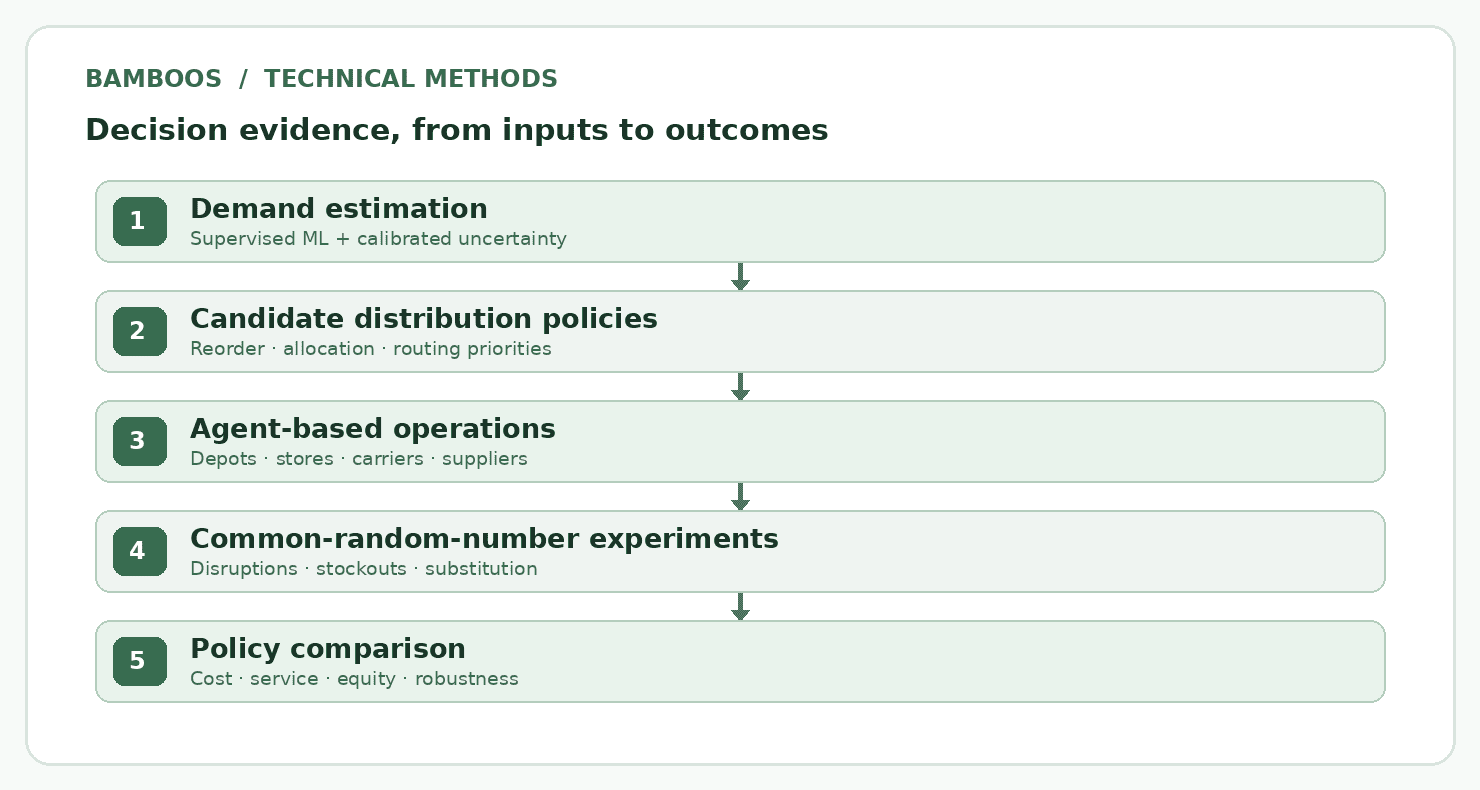
A simple distribution example
Imagine a business with two depots serving six stores. Each store has local demand, while depots have different replenishment lead times and available stock. A national allocation policy distributes goods according to recent sales. A second policy uses machine-learning estimates of near-term demand; a third gives priority to stores with the highest expected shortage cost.
It would be easy to compare one month of historical results and select the policy with the lowest apparent cost. That would not be convincing evidence. The policies may have faced different demand, delivery disruptions, or initial inventory. A simulation experiment instead evaluates the candidates under the same specified conditions, and then tests them on new conditions.
What the learning component should estimate
The learning task may be a point forecast, a set of demand quantiles, or a conditional distribution. Inputs can include lagged sales, price changes, promotions, calendar effects, local economic indicators, and regional demand patterns. A learned probability of delivery delay is another possible input if sufficient historical evidence exists.
A good model must respect the intended information boundary. For example, using the next week’s realized sales as a feature for this week’s replenishment is leakage. Recorded sales during stockouts also require care because the business may have observed only fulfilled demand rather than total demand.
Fit the learning models on historical periods, validate on later periods, and freeze the chosen model before the final simulation comparison. Use simple baselines. M5 forecasting research illustrates both the potential of learned forecasting methods and the importance of a credible evaluation protocol.
What agents represent
In an agent-based representation, a store can observe demand and request replenishment; a depot can accept, defer, or partially fill those requests; a supplier can produce shipments with uncertain lead times; and a carrier can serve a finite delivery capacity. Each actor has a local state and explicit decision rules.
These agents need not imitate human behavior. Their role is to make operational dependencies visible. A depot that allocates its final available units to one store cannot simultaneously ship them to another. A delayed truck changes future inventory, which may produce subsequent orders and congestion. Such feedback can be missed in a one-period spreadsheet calculation.
Define the optimization problem precisely
Optimization requires an objective and feasible choices. One candidate objective is the weighted sum of holding cost, transport cost, shortage cost, and service violations over a specified horizon. Constraints may include truck capacity, stock availability, order multiples, storage space, and delivery windows. The weights should be documented rather than selected merely to produce a preferred answer.
A mixed-integer solver or heuristic can propose allocations or route choices at each decision point. Machine learning need not replace these solvers; it can supply their uncertain inputs or approximate an expensive evaluation function. Standard tools such as Google OR-Tools offer classical baselines against which more elaborate methods can be assessed.
A controlled comparison that avoids misleading results
For each policy, start from identical inventory and simulation settings. Reuse the same exogenous demand and disruption streams where feasible, and run independent replications. Compare average cost and service, but also their dispersion, worst plausible service outcomes, and distribution across stores. Keep model-calibration data separate from final evaluation scenarios.
A useful reporting table has rows for policies and columns for cost per period, fill rate, on-time delivery, peak stock, stockout incidence, and uncertainty intervals. A Pareto comparison is preferable when no policy dominates every objective: a lower-cost policy may require an explicitly accepted reduction in service.
Policy robustness can be examined by changing supplier delays, demand correlations across locations, or the proportion of slow-moving products. If the ranking reverses under modest changes in assumptions, the conclusion should be conditional rather than absolute.
A connection to controller verification
In a related research direction, Verification of Adaptive Agentic Controllers through Finite Rule Revision, Roberto Garrone studies bounded controller diagnosis and re-evaluation in a stylized inventory-control simulation. That work does not validate a complete industrial distribution network; it does illustrate why detecting an undesirable outcome, proposing a rule change, and accepting that change are separate operations.
The same discipline applies here. A simulation can suggest that a learned, allocation-aware policy performs better on selected scenarios. It cannot by itself prove that the policy is optimal across all market conditions or that live operational constraints have been measured correctly.
Where this combination is useful
The approach is particularly relevant when allocation choices feed back into future conditions: multi-depot distribution, constrained replenishment, shared delivery fleets, intermittent demand, and heterogeneous stores. It provides a structured way to ask which policy is preferable, under what assumptions, and with which measurable trade-offs.
Assess Whether Better Forecasts Improve Inventory Performance
Are you evaluating machine-learning forecasts for inventory replenishment, demand planning, or purchasing decisions? Improved prediction accuracy does not necessarily translate into lower inventory costs or better service levels.
Bamboos Consulting can help design an evaluation that connects demand forecasts to actual replenishment decisions. This includes comparing forecasting methods, defining inventory policies, constructing simulation experiments, and measuring their consequences for stockouts, service levels, operating costs, and working capital.
The objective is to establish whether a forecasting approach produces measurable operational improvements over simpler alternatives, and to identify the conditions under which those improvements remain reliable.
Learn more about our Machine Learning & Optimization approach, explore AI Consulting & Computational Systems, and consult the Technical Resources library and Substack for related research and applications.
References
- Makridakis, S., Spiliotis, E., & Assimakopoulos, V. (2022). M5 accuracy competition: Results, findings, and conclusions. International Journal of Forecasting.
- Garrone, R. (2026). Verification of Adaptive Agentic Controllers through Finite Rule Revision. arXiv preprint, 2607.09770.
- Google. OR-Tools: Operations Research and Optimization. Software documentation.