

What should engineering teams test before changing a decision system?
Research on symbolic controllers, edge anomaly detection, experimental design, and adaptive manufacturing suggests four specific evaluation questions for technical decision-makers.
The 1st International Online Conference on Technologies took place November 11–13, 2026. This article distinguishes my own simulation research from three independent conference studies.
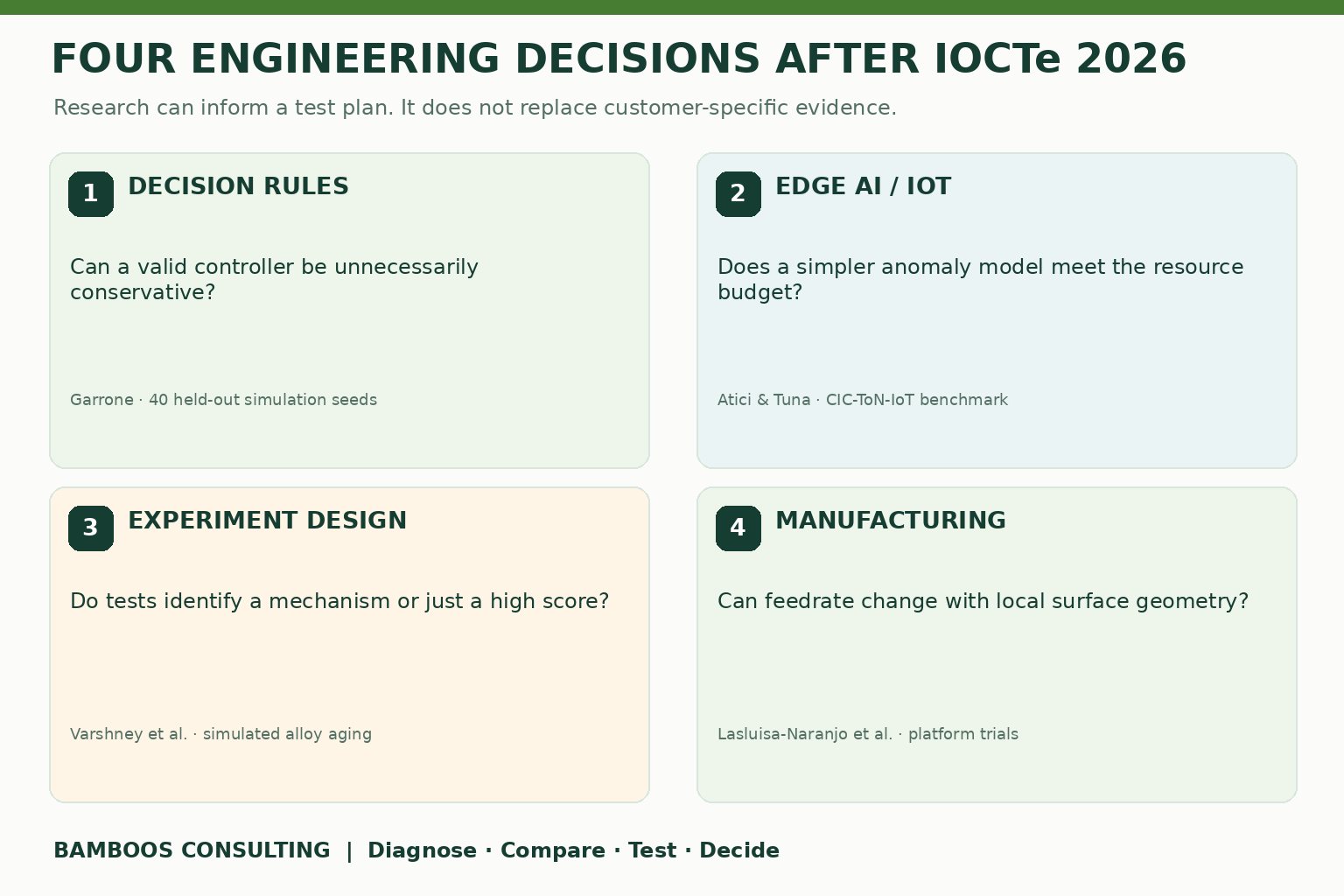
Deploying a better algorithm is not the same as making a better engineering decision. The practical task is to diagnose the current limitation, compare alternatives against a conventional baseline, and define what evidence would justify implementation. Four contributions from IOCTe 2026 make this distinction concrete. They concern different systems, so their reported results should not be pooled or treated as one experiment.

1. When a controller obeys its rules but makes poor decisions
In my IOCTe 2026 contribution, Explanation-Guided Rule Revision for Adaptive Symbolic Controllers, I examined a narrow but important failure mode. A stylized emissions-regulation controller could respect its constraints yet remain excessively conservative. Its actions were represented with explicit predicates, conflicts, and priorities. A predefined explanation-guided template could then introduce a bounded relaxation rule, followed by independent evaluation.
Forty diagnosis seeds were kept separate from 40 held-out evaluation seeds. Across the held-out runs, the reported mean conservatism gap decreased from 6.952 to 0.770, and tracking error from 10.667 to 4.241. Over-conservatism recurrence decreased from 0.875 to 0.000. The reported violation rate, mean overshoot, and policy volatility remained zero; uncertainty estimates were based on 5,000 bootstrap resamples.
The commercial engineering question: Does a client’s rules engine or decision-support controller contain a diagnosable constraint, threshold, or priority interaction that creates unnecessary interventions? A bounded assessment can map current rules, isolate failure cases, propose a small explicit change, and test it on held-out scenarios. The research supports this evaluation method; it is not evidence of customer deployment or guaranteed process savings.
The original research abstract and poster entry are available at Sciforum submission 36914.
2. When detection accuracy competes with runtime constraints
Sinan Atıcı and Gurkan Tuna evaluated machine-learning approaches to anomaly detection for IoT-enabled mechatronic systems using the CIC-ToN-IoT dataset. Their abstract reports binary-classification accuracy above 97% for most evaluated models, while multi-class accuracy was substantially lower, at 68%–72%. Bagged Trees offered the best reported balance of accuracy and computational cost; simpler classifiers remained competitive for binary tasks.
The central distinction is not that a particular algorithm should be purchased. Binary attack detection and attack-type classification are different operational tasks. A small connected device also has compute, memory, latency, energy, connectivity, and maintenance constraints that can matter as much as a headline accuracy score.
The client decision: Is the required task rapid anomaly flagging, detailed event classification, or escalation to an operator? A feasibility assessment can compare a rules-based baseline, a lightweight statistical or ML model, and a more demanding model under a measured resource budget. The conference result is a dataset evaluation, not proof of deployed plant security performance.
3. When experimental optimization leaves the mechanism unknown
Yash Varshney and colleagues studied an experimental-design distinction in simulated alloy age-hardening: choosing tests to maximize a target property is not necessarily the same as choosing tests that discriminate among competing physical explanations. Their study compared disagreement-targeted sampling, greedy property maximization, and Gaussian-process Bayesian optimization across 250 simulated trials with a twelve-experiment budget.
The abstract reports that disagreement-targeted design identified the generating mechanism in 100% of these simulated trials, compared with 2% for greedy maximization and 70% for Bayesian optimization. These are conditional results within the authors’ model assumptions, not a general claim that one optimization method always dominates.
The client decision: Is the immediate objective to find a better process setting, or to reduce uncertainty about why a process behaves as it does? Where the wrong mechanism could invalidate extrapolation, diagnostic tests may be more valuable than another local optimum. This logic is relevant to numerical-model development, sensitivity analysis, process-data readiness, and the design of later calibration campaigns. It does not transfer alloy-aging results directly to die-casting thermal models.
4. When the process setting should depend on local geometry
Héctor Geovanny Lasluisa-Naranjo, David Rivas-Lalaleo, and Joaquin Vaquero-López reported curvature-aware feedrate control for non-planar additive manufacturing. Their workflow uses geometry-derived curvature and a Random Forest trained with instrumented calibration prints to propose local deposition speeds. On the reported lightweight robotic and Bowden-extruder configuration, mean roughness improved by 16% and the share of successful print attempts increased from 40% to 62% relative to the constant-feedrate comparator.
This is a reported hardware test-platform result, under the authors’ equipment, calibration, and experimental conditions. A production company would still need to define its own eligible geometries, process constraints, quality measures, and baseline.
The client decision: Can existing control parameters be adapted to measured geometry or operating conditions, and how should a customized numerical or data workflow be verified before integration? This is a practical entry point for engineering software modernization and simulation-workflow integration.
A practical assessment before committing to a new AI system
These studies point to distinct but compatible consulting tasks. The right starting point is usually not a large platform replacement. It is a bounded analysis of the decision currently being made and the evidence available to change it.
- Diagnose: document the current decision rule, engineering objective, constraints, and recurrent failure cases.
- Compare: retain a conventional comparator—for example a hand-tuned threshold, a simple classifier, or a fixed process parameter—rather than evaluating only more complex AI alternatives.
- Test: select independent simulations, data splits, sensitivity cases, or instrumented measurements appropriate to the system.
- Decide: define acceptance criteria, cost and integration implications, and whether the next step is a pilot, a technical implementation, or additional measurement.
At Bamboos Consulting’s AI Consulting and Computational Systems practice, relevant engagements include decision-rule diagnostics, model and data evaluation, scientific-software modernization, numerical-module development, and simulation-workflow integration. Manufacturing prospects can additionally explore a scoped thermal-data-readiness assessment or feasibility study when the process and measurement context supports it.
Discuss a specific decision, model, or process limitation
Start with the operational question, not the algorithm.
We can review an existing decision workflow, available data, operating constraints, and the evidence needed to compare conventional methods with simulation or AI-based alternatives. The initial discussion can define a bounded diagnostics, feasibility, or engineering-integration work package.
Related: AI Consulting and Computational Systems · Independent technical analysis on Substack · Bamboos Consulting website.
References
- Garrone, R. (2026). Explanation-Guided Rule Revision for Adaptive Symbolic Controllers. IOCTe 2026, Sciforum. https://sciforum.net/paper/36914.
- Atıcı, S., & Tuna, G. (2026). Secure and Efficient Machine Learning-based Anomaly Detection for IoT-enabled Mechatronic Systems. IOCTe 2026, Sciforum. https://sciforum.net/paper/36883.
- Varshney, Y., Sanghi, R., Sindhwani, M., Aggarwal, T., & Tyagi, T. (2026). Mechanism discrimination versus property optimisation in sequential experimental design: a simulation study in alloy age-hardening. IOCTe 2026, Sciforum. https://sciforum.net/paper/36957.
- Lasluisa-Naranjo, H. G., Rivas-Lalaleo, D., & Vaquero-López, J. (2026). Curvature-Aware Feedrate Control for Non-Planar Additive Manufacturing. IOCTe 2026, Sciforum. https://sciforum.net/paper/37005.
- IOCTe 2026. (2026). Official detailed program. https://sciforum.net/event/IOCTe2026/program-overview.