

Which measurements make a die-casting thermal study actionable?
A scoped thermal feasibility project starts with a precise engineering decision, time-aligned evidence, and explicit boundary assumptions.
For foundries, die designers and process engineers considering a thermal data-readiness assessment.

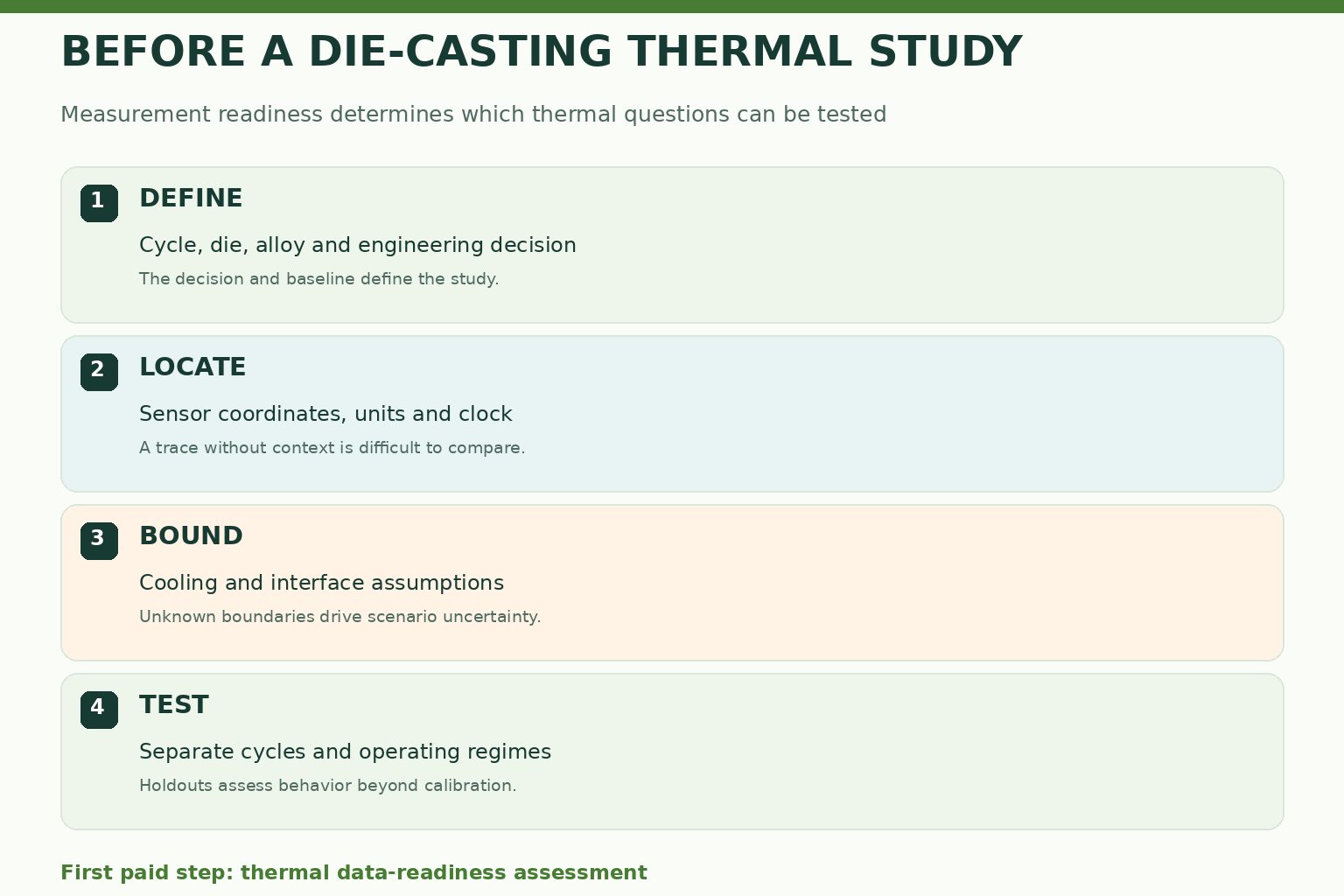
A decision-first measurement contract
A die-temperature trace can be perfectly recorded and still fail to answer the operational question. Before asking whether to change cooling conditions or investigate a thermal anomaly, specify the geometry, cycle phase, thermal variable, alternative operating condition, and observable decision criterion. The objective is not to acquire every possible sensor value. It is to collect evidence that discriminates between plausible explanations or process choices.
1. Identify the model question before requesting data
For a bounded assessment, write one testable decision: for example, whether alternative effective cooling boundary conditions materially change a specified die temperature history over complete cycles. A second question could concern the sensitivity of a local solidification proxy to a material property or interface assumption. These are investigation hypotheses, not claims that a specific process change will yield savings. The baseline may be a measured process condition or a simpler conventional heat-balance approximation.
2. Establish geometry and material provenance
Record the die and insert geometry used for the intended cross-section, alloy and tool grades, and the source and units of conductivity, density, heat capacity and phase-change data. Sensor position must be linked to the model coordinate system, with a documented measurement depth. Record whether material properties are measured, handbook-derived, or assumed. Geometry accuracy can determine whether a 2D study is adequate or whether a narrower scope is needed.
3. Preserve complete cycle timing
A temperature value without a clock and process phase is an ambiguous measurement. The useful unit of evidence is generally the complete, labeled cycle: injection or filling marker, solidification interval, opening, spray/cooling sequence and thermal recovery, subject to instrumentation availability. Keep timestamps, sampling rate, measurement units, sensor channels and cycle identifiers together. Use consistent time bases and record any sensor latency or synchronization uncertainty.
4. Describe interface and cooling conditions explicitly
A thermal study needs an account of heat exchange at metal–die and die–cooling interfaces. External engineering research using inverse heat-transfer methods illustrates why effective heat-transfer coefficients and spatial cooling conditions deserve attention. When measured values are unavailable, they become bounded assumptions to test by sensitivity analysis, not hidden constants. Record cooling-water temperatures, flow settings, channel or jet configuration, spray recipe and other available control logs at the fidelity justified by the question.
5. Separate development cycles from independent comparisons
If process measurements will be used for model configuration or parameter estimation, set aside complete cycles or operating regimes for subsequent checks. Randomly splitting adjacent readings across calibration and evaluation can overstate independence. Compare selected outputs with held-out histories using predeclared criteria: timing of relevant peaks, temporal shape, local temperature error, and sensitivity to uncertain conditions. No universal acceptance threshold should be assumed.
What a paid readiness assessment delivers
A bounded thermal data-readiness assessment can produce a structured inventory of measurements and metadata; an applicability decision on geometry and model fidelity; a ranked list of missing evidence; a baseline-and-alternatives test matrix; and the scope of a subsequent feasibility study. When sufficient measurements exist, the next stage can configure a customer-specific model and assess selected scenarios. The value of the first stage is reducing ambiguity before committing to larger modeling work.
Where HPDC-Twin fits
Bamboos Consulting has developed an HPDC-Twin C++17 thermal and solidification research prototype with a Python/Jupyter analysis workflow. It supports reproducible synthetic scenario studies, numerical diagnostics and sensitivity investigations in the current two-dimensional formulation. The established canonical HPDC technical article describes the implemented workflow. This new measurement contract complements that source rather than representing a second product or a separate deployment outcome.
Assess whether your HPDC process data can support the next engineering decision
Begin with the process question and existing evidence, not an unconstrained model build.
Discuss the component, die, cooling question and process records already available. We can define a paid thermal data-readiness gate, a prioritized measurement plan, and a bounded feasibility scope before any larger calibration or validation work.
Related: AI Consulting and Computational Systems · Technical Resources · Independent analytical essays.
References
- Bamboos Consulting (2026). Thermal Simulation in High-Pressure Die Casting: From Process Understanding to Engineering Decisions. https://www.bamboos-consulting.com/blog/thermal-simulation-high-pressure-die-casting-engineering-decisions/.
- Bohacek et al. (2023). Experimental and Numerical Investigations into Heat Transfer Using a Jet Cooler in High-Pressure Die Casting. Journal of Manufacturing and Materials Processing, 7(6), 212. https://www.mdpi.com/2504-4494/7/6/212.
- Iacovelli, V., Piccininni, A., Guglielmi, P., & Palumbo, G. (2024). Accurate tuning by inverse methodology of the numerical model for efficiently simulating the high pressure die casting process. International Journal of Heat and Mass Transfer. https://www.sciencedirect.com/science/article/pii/S0017931024010184.
- Teamah et al. (2025). Experimental and Numerical Replication of Thermal Conditions in High-Pressure Die-Casting Process. Processes, 13(12), 3815. https://www.mdpi.com/2227-9717/13/12/3815.