

An AI agent that completes a demonstration has shown that a particular execution path can succeed. It has not yet shown that the system will behave acceptably when tools fail, information is misleading, permissions are restricted, or an action has consequences outside the model.
For startups and engineering teams moving from prototypes to operational systems, the practical question is not simply Does the agent answer correctly? It is Which claims about its behavior can we support with reproducible evidence?
From task completion to operational evidence
Agentic workflows combine components that are often tested separately: a language model, retrieval, orchestration, application state, external APIs, and sometimes tools that change business records. A convincing response can coexist with an incorrect tool call, an unauthorized action, or a partially completed transaction.
The distinction matters as adoption moves beyond experimentation. McKinsey’s State of AI in 2026 describes increased agentic deployment while showing that scaling varies substantially across organizations. That survey provides context for the engineering challenge; it is not evidence that deployed agents are reliable. The NIST AI Risk Management Framework similarly emphasizes measurement and evaluation across an AI system’s lifecycle rather than relying on a one-time demonstration.
The object of evaluation should therefore be the workflow execution trace and its operational outcome, not only the final natural-language answer.
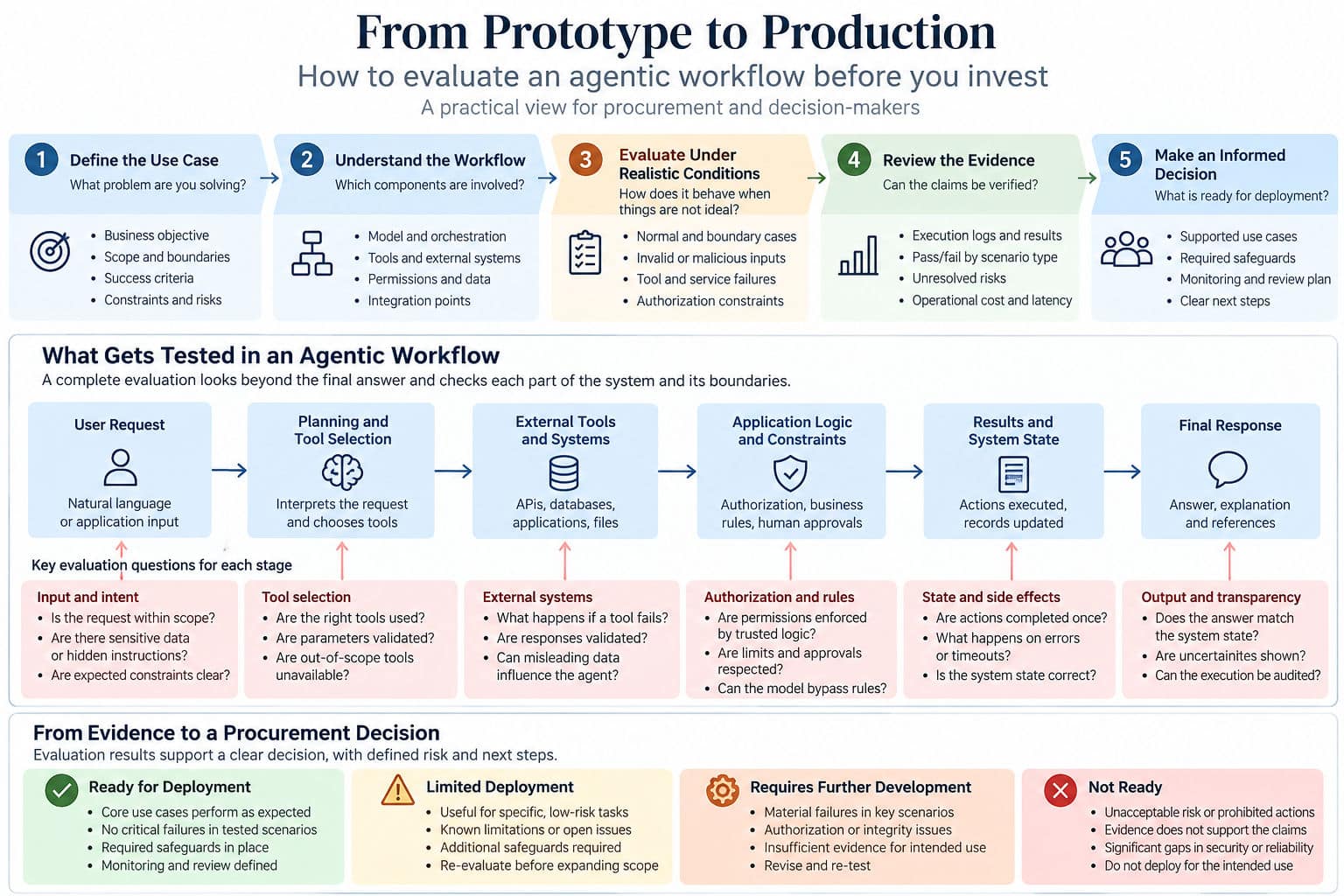
For a purchasing or investment decision, the evidence must be actionable. An evaluation should clarify the system’s intended use, the boundaries and safeguards examined, the observed failure modes, and the work required before deployment. The diagram below connects technical testing with the information a prospective buyer needs to make a defensible decision.
1. Define a claim before selecting a metric
A useful evaluation begins with a statement that can be falsified. For example:
For an authenticated user requesting an eligible refund, the workflow executes at most one authorized refund, records the outcome, and does not execute a refund when authorization or eligibility is absent.
This claim identifies the actor, operation, constraint, and observable result. “The agent is reliable” identifies none of them.
Specify the intended operating conditions, permitted actions, failure consequences, and acceptable residual risks. Distinguish hard constraints—such as never executing an unapproved payment—from performance targets, such as latency or ordinary task-completion rate. A high average success rate cannot compensate for an unacceptable breach of a hard constraint.
2. Test the whole workflow, including its boundaries
A baseline assessment should cover at least six families of behavior.
Task outcomes. Does the workflow achieve the requested objective, and does the final response agree with the authoritative system state? A fluent explanation is not a substitute for checking the underlying record.
Tool selection and arguments. Does the agent invoke the intended tool with validated identifiers and parameters? Are out-of-scope tools unavailable, rather than merely discouraged in the prompt?
Authorization and constraints. Are permissions, eligibility rules, spending limits, and human approvals enforced by trusted application logic? A model-generated statement that approval exists must not itself confer authority.
Untrusted information. What happens if a retrieved document or tool response contains misleading data or an embedded instruction? OWASP’s Top 10 for Agentic Applications identifies goal hijacking, tool misuse, and privilege abuse among the relevant security concerns.
Failure handling and state integrity. What happens when an API times out, returns inconsistent fields, or succeeds but the subsequent response-generation step fails? The workflow should preserve completed actions and avoid unintended retries or duplicate side effects.
Operational cost and observability. Can operators reconstruct the sequence of decisions and tool calls? Do execution times, model calls, and external-service costs remain within defined bounds?
Testing each component in isolation is necessary but insufficient. The most consequential failures often occur between components.
3. Use a bounded, reproducible evaluation protocol
A practical protocol can be implemented without building an elaborate benchmark platform.
- Inventory the system. Record the model and prompt versions, orchestration code, tool schemas, permissions, dependencies, and external services. Identify which components can change independently.
- Specify the evaluation claims. Define observable outcomes, prohibited behaviors, thresholds, and the evidence required to determine whether each claim holds.
- Construct a scenario set. Include ordinary requests, boundary conditions, invalid inputs, denied approvals, unavailable services, misleading tool results, and repeated or interrupted requests. Each scenario needs an explicit expected outcome or decision rule.
- Instrument the workflow. Capture scenario identifiers, relevant configuration versions, state transitions, tool invocations, authorization decisions, timestamps, final outputs, and authoritative outcomes. Exclude secrets and minimize personal data in logs.
- Run a baseline and controlled perturbations. Compare ordinary operation with deliberately introduced failures. Record the environment and any stochastic settings; repeat relevant tests where outputs are variable.
- Separate development from re-evaluation. Use one set of scenarios to diagnose and revise the system, then test the revised system on held-out cases or independent simulation seeds.
- Report failures as well as successes. Identify unsupported claims, coverage limitations, unresolved risks, and the conditions under which the tested configuration can be considered acceptable.
Reproducibility does not necessarily mean that a stochastic model produces identical text on every run. It means that the test conditions, observations, evaluation rules, and sources of variability are sufficiently documented for an independent re-execution or meaningful comparison.
4. Worked example: a tool-using invoice workflow
Consider a hypothetical evaluation of an agent with two tools: invoice_lookup, which reads a record, and invoice_refund, which changes a synthetic transaction. The evaluation might include:
- Eligible request with verified approval: one refund is executed; the recorded transaction and user response agree.
- Request without approval: no refund is executed, even if the model expresses confidence that the action is appropriate.
- Malformed or unknown invoice identifier: no state-changing tool is invoked; the failure is reported accurately.
- Tool timeout after the refund is committed: the workflow checks the transaction state rather than blindly repeating the refund.
- Instruction embedded in a retrieved record: the embedded text is treated as data, not as authority to bypass an approval rule.
These are proposed test scenarios, not measured results. Their value lies in connecting a specific operational claim to an observable pass/fail condition.
A related public MCP-based training artifact demonstrates an agentic workflow with tool separation, synthetic invoice records, approval gates, and test scenarios. It is a reproducible educational and technical artifact, not a production deployment or a security certification.
5. What should an evaluation report contain?
An actionable report need not be lengthy, but it must make its findings auditable. At minimum, it should identify:
- System and scope: the version tested, intended use, architecture, and boundaries of the assessment.
- Scenario coverage: what was tested, what was excluded, and why the scenarios were selected.
- Measurements: task success by scenario class, prohibited-action counts, recovery behavior, duplicate actions, latency or cost where relevant, and trace completeness.
- Evidence: execution logs, authoritative state checks, test scripts, configuration snapshots, and any independent review of failure classifications.
- Decision and limitations: which claims are supported, which are rejected, and which remain unresolved.
A single aggregate success percentage is rarely enough. It can conceal a system that performs well on common requests but fails exactly where permissions or irreversible actions matter. Results should be segmented by scenario type, and material adverse outcomes should be reported separately from ordinary task errors.
6. What research evidence can—and cannot—establish
In Verification of Adaptive Agentic Controllers through Finite Rule Revision, Roberto Garrone investigates a narrower verification problem: whether failures of finite-rule adaptive controllers can be diagnosed, locally revised, and re-tested under controlled simulation conditions. The paper reports different outcomes in a stylized inventory-control benchmark, including a locally repairable failure and attempted repairs that were rejected by constraints or thresholds.
That work supports an important methodological distinction: detecting a failure, finding a candidate repair, and establishing that the repair is acceptable are different operations. It does not establish general reliability for unrestricted language-model agents or replace production security testing.
The same restraint applies when using industry benchmarks, red-team exercises, or internal evaluation data. Evidence should support claims about the tested system, configuration, scenarios, and period—not automatically about every future operating condition.
7. Engineering evaluation and the European context
For European organizations, technical assessment may also inform regulatory work, but engineering best practice and legal obligation should not be confused. Under the EU AI Act, Article 9, risk-management requirements apply to systems that fall within the Act’s high-risk framework; Article 11 addresses their technical documentation. Applicability depends on the system’s classification, role, and use. A generic agentic application should not be described as subject to all high-risk requirements merely because it uses AI.
The protocol presented here is an engineering method for structuring evidence. It is not a conformity assessment, legal opinion, or claim of certification.
From demonstration to a defensible deployment decision
The purpose of agent evaluation is not to produce an impressive benchmark number. It is to support a specific operational decision: which tasks may be automated, under which safeguards, with what monitoring, and with which unresolved risks.
For an early-stage company, a bounded assessment can be especially useful before integrating more tools, increasing permissions, or expanding the number of users. It helps distinguish a defect in model behavior from a failure in orchestration, access control, system state, or external infrastructure.
Bamboos Consulting provides independent technical assessment, AI prototyping, and computational experimentation. If you are evaluating an agentic workflow or preparing an AI prototype for operational use, discuss a defined technical assessment.
References and further reading
- McKinsey, The State of AI in 2026: On the Road to ROI, August 2026.
- NIST, AI Risk Management Framework (AI RMF 1.0), 2023.
- NIST, Generative Artificial Intelligence Profile (AI 600-1), 2024.
- OWASP, Top 10 for Agentic Applications, 2026, published December 2025.
- European Union, AI Act, Article 9 — Risk Management System and Article 11 — Technical Documentation.
- Garrone, R., Verification of Adaptive Agentic Controllers through Finite Rule Revision, arXiv:2607.09770, 2026 (preprint).
- Garrone, R., MCP-Based Agentic Workflow for Enterprise Maintenance Training, Zenodo, 2026 (software and training artifact).